▸ All three books read as one story, and the answer they arrive at
The First Law Trilogy by Joe Abercrombie: People Do Change, and It Doesn’t Save Them
| SUBJECT | Joe Abercrombie |
| PUBLISHED | THE FIRST LAW TRILOGY (PUBLISHED 2006 TO 2008) |
| RUNTIME | 11:12 |
| STATUS | CHANGE, AND NO ESCAPE |
Joe Abercrombie wrote the The First Law trilogy between 2006 and 2008, and they sat on my shelf for years before I opened them. I’ve now read all three and covered each one on its own: The Blade Itself, Before They Are Hanged, and Last Argument of Kings. This is the piece where I stand back and look at them as a whole, because the trilogy does something across three books that none of them does alone.
Book one asks whether people can change. Book two begins to answer. Book three finishes the answer and then reveals who was pulling the strings. Taken together, the trilogy makes the argument that people can change, but it costs them everything and doesn’t set a single one of them free. Growth is real in this world. It’s just not the thing that decides anything.
One confession up front. When I first talked about this trilogy on video, I walked through Logen, Glokta, and Jezal, but I left out Ferro Maljinn completely. I think I actually forgot about her in my review of The Blade Itself as well. I’m not entirely sure why, but I didn’t resonate with her as much as the other characters. However, she is pivotal to the conclusion of the trilogy, so I make up for it in this written essay.
A warning before we go on: this is a full-spoiler look at all three books, which means I discuss every major reveal, where each character lands, and exactly how the trilogy ends. The video up top is the spoiler-free cut. If you haven’t finished Last Argument of Kings, watch that one and come back.

The world, in one pass
The Union is a large, comfortable, badly run empire with a dying king, a nobility that has never been told no, and a secret police called the Inquisition doing the work nobody wants named. It’s being squeezed from two directions.
In the North, a warlord named Bethod has united the clans and is pushing over the border. In the South, the Gurkish Empire and its prophet, Khalul, are moving on Union territory with things in their ranks that used to be men.
Above all of it sit the Magi, a handful of very old survivors of a broken magical order, chief among them Bayaz, the First of the Magi, who talks like a kindly mentor and behaves like a man who has been playing the same game for six hundred years.

What Abercrombie does with the world is spend three books setting up the standard epic fantasy moves and then declining every one of them. A fellowship assembles and goes west after an ancient weapon, but the weapon isn’t there. A siege is defended brilliantly, and the city falls anyway because of a decision made in a room the defender was never invited into. A war in the North gets fought by a prince whose entire qualification is his blood, and it goes exactly as well as that sounds. Each of those is a promise the genre has trained you to expect payment on, and each one is deliberately not paid.
The world-building carries itself the same way. Abercrombie almost never stops to explain his history to you. What you get instead is texture: a scar somebody won’t talk about, a ruined city that used to matter, a Northern custom nobody bothers to gloss. The Old Empire in the west is a corpse the size of a continent, still grinding through a civil war that has long since ceased to mean anything, and the company walks through it without anyone giving a lecture. By the end, you know this place, and you can’t point to the paragraph where you learned it.

The people, which is the entire reason
If you take one thing from this review, it’s that the characters are the reason these books work, and everything else is the machinery that puts them under load. Abercrombie hands you people the genre has already told you how to feel about, then makes you feel the opposite, and he does it without ever asking you to forget what they’ve done.
Logen Ninefingers is a barbarian whose glory days are behind him and who would like, sincerely, to stop. He’s gentle in conversation, careful with people, funny in a resigned sort of way, and he has murdered a staggering number of men. When the fighting starts, something called the Bloody-Nine comes out, and it isn’t a metaphor for a bad temper. Logen’s whole arc is a man trying to be realistic about what he is, while everyone around him keeps needing the worst version of him to show up. He’s the trilogy’s clearest statement of its thesis, and he doesn’t get to notice.
Sand dan Glokta is the best thing in the series, and I’ll die on that hill. A brilliant young swordsman captured in war, tortured for two years, and returned to the Union as a wreck who can barely walk, he now works as an Inquisitor, doing to other people what was done to him. His chapters run on interior monologue, and that voice is one of the funniest and most miserable things in modern fantasy: he narrates his own cruelty with total clarity, hates himself accurately rather than sentimentally, and keeps going because the alternative is stopping. He does terrible things on the page. You root for him anyway, and Abercrombie never lets you feel clean about it.
Jezal dan Luthar is the vain, lazy, spectacularly privileged young officer you’re handed specifically so you’ll roll your eyes at him. He cares about fencing, cards, and being admired. Then Abercrombie drags him across a continent, takes away every comfort and every audience, and lets him improve by degrees so small you can’t find the page where it happened. He gets a mace in the face for his trouble. The looks he banked his identity on are gone, and the better man underneath arrives in the same chapter as the scars.
Around those three sit people who’d be leads in a lesser series. Collem West, a commoner promoted above his station, carrying a temper he’s terrified of. The Dogman and the Named Men, who gave me some of my favorite chapters in the whole trilogy, and whose voice is the most quietly human thing in it. Bayaz, the wizard, whose motives stay murky for two and a half books and then stop being murky in the worst possible way.
Ferro Maljinn, the one I left out
Ferro is a Gurkish woman who was sold into slavery as a child, escaped, and has spent every year since killing Gurkish soldiers in the Badlands, alone, on the reasonable theory that she’ll die doing it and that this is fine. She has yellow eyes. There’s something old in her blood that isn’t human, which is why the Eaters, the prophet Khalul’s cannibal servants, keep turning up wherever she is. The Magus Yulwei finds her mid-slaughter, tells her she’s going to burn herself down to nothing, and brings her north to Bayaz. She goes because there might be a bigger revenge at the end of it. That’s the only currency she deals in.
She matters structurally for a reason that took me a second read to see. Logen, Glokta, Jezal, and West are all inside the system: Union or North, soldier or noble or spy, arguing about their place in an arrangement they take for granted. Ferro is the only lead who comes from outside it entirely, and she does not care about any of it. The Union’s politics are noise. The Northern war is somebody else’s problem. The great quest west is a means to an end she’d happily abandon the moment it stopped pointing at the Gurkish. Every time the story tries to make her care about the shape of the world, she declines, and it’s clarifying, because she’s the only one in the cast who never mistakes the game for something worth winning.
Her relationship with Logen in Before They Are Hanged is one of the best things in the middle book, and it works because neither of them has the equipment for it. Two people with catastrophic histories, thrown together on a long road, fumbling toward something like tenderness and then flinching away from it every time it gets close. Abercrombie writes their mutual incompetence at intimacy with more patience than he gives almost anything else in the trilogy. Nothing about it is triumphant. It’s two damaged people discovering that being known is worse than being alone, and choosing alone.
And then the finale, where she turns into the argument. Ferro is the one who can hold the Seed, the relic the whole failed quest was chasing, because of what’s in her blood. It changes her permanently. She kills the Eater Mamun with what it leaves behind in her. And when the dust settles and the book offers her the two endings fantasy usually keeps in stock, she takes neither. She isn’t cured of her hatred, and she doesn’t stay for the people who’ve come to care about her. She goes south, alone, still hunting Khalul, carrying whatever the Seed put in her. Abercrombie lets her walk out of the trilogy without softening one thing about her.
She was the flattest of the leads through the first two books, and I’ll say that plainly, because a lot of her early material is one note struck repeatedly. The finale is where she becomes one of the best things in the series, and where I understood why he’d been holding her back. Leaving her out of my original review meant leaving out the only person in the story who gets to keep herself.
The question, and the answer that took three books
Almost every character in this trilogy states, out loud, an intention to be something better. Logen wants to stop killing. Glokta wants, on the rare occasions he admits it, to be something other than the thing Sult uses. Jezal wants to deserve Ardee. West wants to control his temper. Ferro wants nothing, which turns out to be its own answer. Abercrombie sets that up in book one and then spends two thousand pages testing it under conditions nobody would choose.
“You have to be realistic about these things.”
Logen’s line is the trilogy’s thesis pretending to be a shrug. And the answer the books arrive at is more interesting than the cynical one everybody assumes. It would be easy, and boring, for Abercrombie to say people never change. He says something harder. They do change, all of them, visibly and permanently. Jezal is a better man at the end than at the start. West becomes a commander worth following. Glokta’s self-knowledge is total by the finale. The change is genuine and it’s earned through suffering, exactly the way the genre promises.
Then Abercrombie shows you that it buys nothing. Jezal becomes worth respecting and is installed on a throne as a decoration. West becomes the best officer in the Union and dies slowly of a sickness set off by a weapon he had no say in. Logen genuinely wants to be better and ends the trilogy going out a window into water, exactly as he began it, because the Bloody-Nine is what the world keeps ordering from him. Glokta gets everything he clawed for and finds it was somebody else’s chair the whole time. The change is real. The world simply doesn’t run on it.
Ferro is the control case. She’s the one who refuses to be improved, refuses the ending, and walks out with her hatred intact, and she’s the only one who ends up holding something of her own. That’s a bleak thing to conclude, and I don’t think Abercrombie is endorsing it so much as putting it on the table. In a world run by people who own the board, the only autonomy on offer is the kind you take by leaving.
Bayaz, and who was holding the board
Everything above only lands because of what the finale reveals about the man who’s been standing helpfully in frame since chapter one. Bayaz turns out to own Valint and Balk, the bank whose debts have been tightening around Glokta’s throat for two books, which means he’s owned the Union’s finances for centuries. Every political crisis you watched was happening inside walls he built. He manufactures a king out of Jezal, complete with a royal parentage he later says he invented. In the House of the Maker, Tolomei tells the founding story with Bayaz as the murderer rather than the avenger, and he has an answer for it, as he always does, and you’re left holding two versions with no referee.
Then he uses the Seed on his own capital city, kills the Gurkish army along with an enormous number of the people he claims to be defending, and leaves a wasting sickness working through the survivors. And underneath all of it sits the smallest and worst fact in the trilogy: his war with Khalul is a personal feud between two very old men, and two empires’ worth of soldiers, cities, and characters you’ve spent three books caring about are ammunition in it. Nobody in this story dies for a cause. They die inside an argument they were never told about.
What makes it work rather than feel like a cheat is that none of it is smuggled in. The foreshadowing is sitting in the open across all three books, in Bayaz’s convenient arrivals, in his interest in a mid-ranking officer nobody else could see a use for, in the fact that he’s never once asked to justify himself. Going back through it, the sensation isn’t disbelief. It’s the much better feeling of wondering how you managed to miss it.
The jokes are load-bearing
This trilogy is very funny, and I want to be specific about why that matters rather than just noting it. Grimdark tends toward one of two failure states: unbroken bleakness that numbs you by page three hundred, or tonal whiplash where the comedy sits on top of the horror without touching it. Abercrombie does neither. The humor comes out of character, mostly out of how these people talk to themselves, and it’s doing structural work.
Glokta’s interior monologue is the clearest case. He’s a torturer. If you had to sit in his head straight, you’d get out after a chapter. Because he’s hilarious about it, dry and self-lacerating and quick, you stay, and staying is how the sympathy gets in past your judgment. The comedy is the delivery mechanism for the empathy, which is a genuinely difficult trick, and it’s why people come out of these books fond of a man who breaks fingers for a living.
You can feel Abercrombie’s old trade in the timing, too. He cut film before he wrote novels, and it shows in how he places things: a joke landing one beat after a death so each one sharpens the other, a reveal held exactly as long as it can bear, three storylines cross-cut so the cut itself does the commentary. That’s editorial instinct, and it’s rarer in fantasy prose than it should be.
What the three books add up to
Read as one long book, The First Law is the most impactful character-driven story I’ve found in twenty-five years of reading fantasy, and the reason is that Abercrombie never once flinched to keep me comfortable. He built a torturer I root for, an arrogant fop I ended up mourning, a killer whose worst self keeps saving everyone, and a woman who refuses every offer the story makes her. Then he declined to redeem any of them on schedule. That’s a harder trick than a good twist. It’s a writer taking real risks with people readers have already paid to care about, and getting away with it because the characters were always the point and the plot was the delivery system.
I should be honest about where it’s uneven, because I’ve now said this about each book individually and it’s true of the whole. The endings are the weak seam. Book one stops rather than concludes, book two’s ending I found less than stellar, and even the finale, which absolutely works for me, isn’t conclusive: Khalul is still out there, Ferro is walking south, Logen is in the water. Ferro herself is thin for most of two books before the finale rescues her. And the opening stretch of The Blade Itself asks for patience that some readers reasonably decline to give. None of that stops the trilogy from raising the bar on what I expect from the genre, but I’d rather name it than pretend the thing is flawless.
Who it’s for, and who it isn’t
Read this if you’re tired of clean heroes and clear villains and want a story that makes you check your own sympathies. Read it if you like your politics knotted and your dialogue sharp. If you enjoyed A Song of Ice and Fire for the way its point-of-view chapters keep rearranging your loyalties, or Glen Cook’s The Black Company for its flat, tired, professional view of war, you’re in the right neighborhood. Glokta’s chapters on their own justify the time.
Skip it if you want escapist comfort fantasy where virtue is rewarded and the ending ties off. This world is cruel and the cruelty isn’t decorative. There’s torture on the page, described by the man performing it. The war chapters have no glory in them anywhere. Nobody gets the ending they earned, which is the whole point and also a genuinely bad time if that isn’t what you came for. Anyone who tells you this trilogy is for everyone hasn’t met enough readers.
My format recommendation is the audio. Steven Pacey narrates all three books, and he keeps a very large cast straight while landing Abercrombie’s humor better than most of us manage in our own heads. His Glokta alone is worth it. If you’re on the fence about the trilogy at all, that’s the version I’d start with.


Where to start, and what comes after
Start at the start. The Blade Itself (2006), then Before They Are Hanged (2007), then Last Argument of Kings (2008). There’s no alternate order and no way to skip the first book, since it’s doing the character work that every later payoff draws on.
After that, stay in publication order. The standalones come next, Best Served Cold first, then The Heroes and Red Country, each returning to this world with faces you’ll recognize. Sharp Ends, the short story collection, fills gaps along the way. Then the Age of Madness trilogy starts with A Little Hatred (2019) and jumps a generation forward into the wreckage Bayaz left running. Publication order means you meet each consequence in the order it was designed to hit you.
The First Law made me question what I want out of a fantasy ending, and it did it without a single cheap move. That’s why all three stay on my shelf, and why I’m already into the standalones.
Have you read all three? Did the ending land for you or did it feel like a betrayal, and where did you come down on Ferro walking away? Tell me in the comments.
Read or hear The First Law yourself
Mysterious Galaxies is a Libro.fm and Bookshop.org affiliate. If you buy the audiobooks or the print set through the links below, the channel earns a small commission at no extra cost to you.
The audiobooks, narrated by Steven Pacey
The Blade Itself

Before They Are Hanged
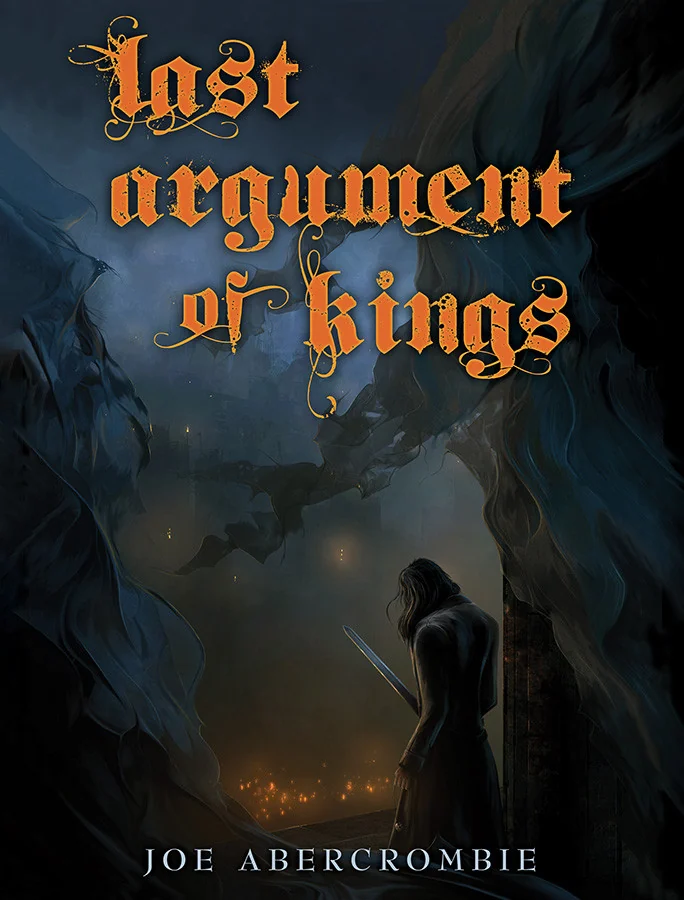
Last Argument of Kings
The complete trilogy in print

If you’d rather own the trilogy in something nicer than a paperback, Lit Escalates put out a special edition hardcover of all three books through Kickstarter, with oil-painted dust jackets by Joel Daniel Phillips. I went through the whole set, what the paper and binding specifications actually mean, and the damage that turned up in my box in my review of the Lit Escalates First Law set.
FAQs
What is The First Law trilogy about?
The First Law is a grimdark fantasy trilogy by Joe Abercrombie, made up of The Blade Itself (2006), Before They Are Hanged (2007), and Last Argument of Kings (2008). The Union, a large and badly run empire, is attacked from the North by the warlord Bethod and from the South by the Gurkish Empire, while the wizard Bayaz leads a small company west after an ancient weapon. It follows a barbarian trying to stop killing, a crippled torturer working for the Inquisition, a vain young officer, and an escaped Gurkish slave hunting revenge, and it’s far more interested in what happens to those four people than in who wins the wars.
What order should I read The First Law books in?
Publication order, with no shortcuts. The Blade Itself, then Before They Are Hanged, then Last Argument of Kings. After the trilogy, read the standalones in order (Best Served Cold, The Heroes, Red Country), then the Age of Madness trilogy beginning with A Little Hatred. The collection Sharp Ends fits anywhere after the trilogy.
Who is Ferro Maljinn?
Ferro Maljinn is one of the trilogy’s point-of-view characters, a Gurkish woman sold into slavery as a child who escaped and spent years killing Gurkish soldiers alone in the Badlands. The Magus Yulwei finds her and brings her to Bayaz, and she joins the company that travels west after the Seed. There’s something inhuman in her blood, which is why the prophet Khalul’s Eaters hunt her and why she can hold the Seed when it would destroy anyone else. She’s the only major character who comes from outside the Union and the North, and the only one who ends the trilogy on her own terms.
Is The First Law worth reading?
For me, yes, and it’s the most impactful character-driven fantasy I’ve read in twenty-five years. The reason is the cast rather than the plot: Abercrombie writes people you have every reason to despise and then makes you care about them without asking you to excuse anything. If you need your fantasy to reward virtue and tie off cleanly, this isn’t the series for you, and that’s a real answer rather than a hedge.
Is Bayaz the villain of The First Law?
He’s the closest thing the trilogy has to one, though Abercrombie never makes it that tidy. By the end of Last Argument of Kings, Bayaz is revealed to own the bank Valint and Balk and through it much of the Union, to have manufactured a king out of Jezal, and to have set off a weapon that devastates his own capital along with the invading army. Tolomei contradicts his account of his own history. His centuries-long feud with the prophet Khalul, which consumes two empires, comes down to a personal quarrel between two very old men.
How dark is The First Law?
Very. It’s one of the books that defined modern grimdark. There’s torture described from the point of view of the man doing it, battlefield violence with no glory anywhere in it, and characters who die pointlessly rather than meaningfully. Abercrombie cuts it with humor and never plays the brutality for cheap shock, but this is firmly adult fantasy for readers who don’t need their heroes clean.
Should I read The First Law or listen to the audiobooks?
The audiobooks are my recommendation. Steven Pacey narrates all three, and his performance is the single best argument for taking these in audio. He keeps a very large cast distinct and lands Abercrombie’s humor better than most readers will in their heads, which matters a lot in a series where the comedy is doing the emotional work. The unabridged recordings are on Libro.fm through the links above.
Does The First Law have a happy ending?
No, and it isn’t conclusive either. Jezal ends up on a throne as somebody else’s puppet, Logen goes out a window into water with his fate left open, Glokta gets the Arch Lector’s chair along with the leash that comes with it, West dies of the sickness that follows the Seed, and Ferro walks south alone still hunting Khalul. Threads are left hanging on purpose. Readers who want suffering to purchase transformation tend to feel cheated. I found it earned, and I’d still call the ending the weakest seam in a trilogy I love.
Sources
- The First Law Trilogy, Hachette Book Group (the Orbit trade paperback set of all three novels, 1,680 pages, ISBN 9780316361194)
- The Blade Itself, Hachette Book Group (the unabridged Hachette Audio recording narrated by Steven Pacey)
SOURCE · Joe Abercrombie, The First Law trilogy (published 2006 to 2008). SERIES · The First Law.
Transmissions from ground control