▸ Book two of The First Law, and the middle book that refuses to sag
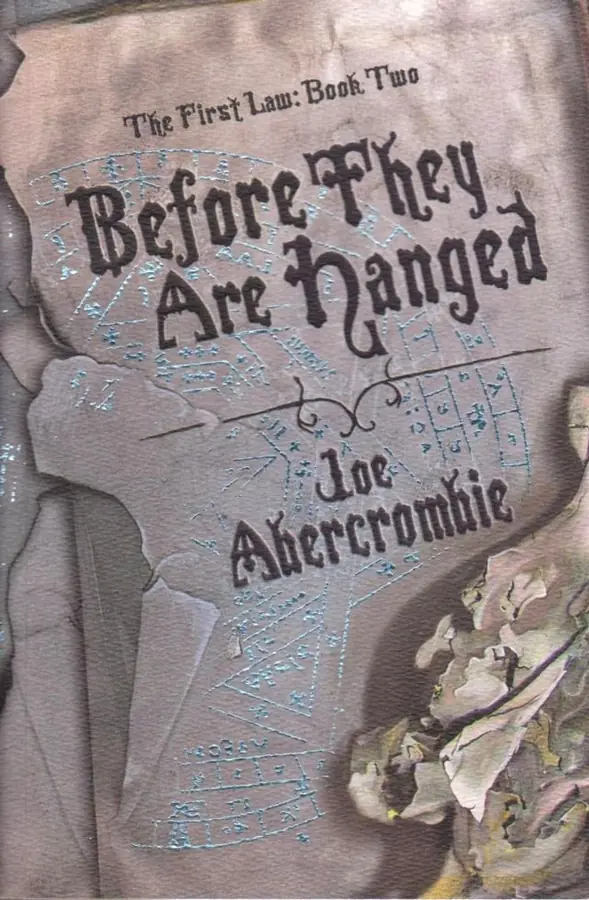
Before They Are Hanged by Joe Abercrombie: The Rare Middle Book That’s Somehow Even Better
| SUBJECT | Joe Abercrombie |
| PUBLISHED | BEFORE THEY ARE HANGED (PUBLISHED 2007) |
| RUNTIME | 17:03 |
| STATUS | CHANGE, AT KNIFEPOINT |
Joe Abercrombie published Before They Are Hanged in 2007, one year after the debut that had basically reset my expectations for the whole genre. It’s the second book of the First Law trilogy, and like the first one, it sat on my shelf for years while I told myself I’d get to it. When I finally did, I went in braced for the thing that ruins so many trilogies. The middle book is where stories usually stall: the setup is spent, the ending is too far off to reach for, and the author treads water for four hundred pages to get you from book one to book three. Before They Are Hanged doesn’t do that. Somehow it’s even better than The Blade Itself.
Here’s why, and it’s the same trick Abercrombie has been running the whole time, only now you can see it working. The Blade Itself asked whether people can change. Before They Are Hanged is where he starts to answer that question. This is the book where he hands you one of my favorite tropes in all of epic fantasy: a fellowship setting out on a quest. This time, we get a search for a world-saving weapon, a coward who might become a hero, a soldier earning his name in war, and then turns every one of those promises against you. The fellowship never becomes a fellowship. The quest comes back empty. The growth is real, but it gets beaten into people rather than earned in triumph. A middle book is supposed to be a bridge. Abercrombie builds a trap instead, and springs it on your expectations one at a time.
A warning before we go on: this is a full analysis of the second book, which means I discuss how every thread ends and exactly where the trilogy parks its people before the finale. The video review up top is the spoiler-free version. If you’ve only read The Blade Itself, or you’re partway through this one, that cut is the safer place to be.

Two wars and a doomed road
The first book kept its three point-of-view threads almost entirely apart and spent its length introducing people. This one puts those people to work and scatters them across a map that’s suddenly much bigger than Adua.
The Union is now being squeezed from two directions at once, exactly as book one warned. In the North, Bethod’s Northmen have poured over the border into Angland, and the Union answers with the worst army it can assemble, a rabble handed to Crown Prince Ladisla, a man whose only qualification for command is his blood.
In the South, the Gurkish Empire has laid siege to the Union city of Dagoska, and the man sent to hold it is Sand dan Glokta. The same man who was shipped off in the first book, on what everyone understood to be a death sentence. And running underneath both wars, ignoring them entirely, is Bayaz, leading his small company west toward the edge of the world after a weapon out of the Old Time.
Two of these threads, the siege and the war, are the grand set pieces of epic fantasy, and the third is the classic quest. Abercrombie lines all three up so he can knock each one down in a different way. The siege is won on the walls and lost in a back room. The war is a slaughter run by fools. The quest is a long walk to nowhere.
By the end of the book every large heroic shape you were promised has been deflated, and what’s left standing is the only thing Abercrombie ever really cares about, which is what all of this does to the people caught inside it.
The quest that comes back empty
Bayaz’s expedition is the clearest place to watch Abercrombie work, because it’s the most familiar shape in the genre, and he refuses to let it behave. The company is Bayaz himself, his sickly apprentice Malacus Quai, the absurdly self-regarding navigator Brother Longfoot, Logen Ninefingers, the escaped Gurkish slave Ferro Maljinn, and Jezal dan Luthar, dragged along out of the only life he understands.
On paper, this is the Fellowship: a wizard, a warrior, a rogue, a party bound for the far edge of the map to fetch the thing that will turn back the darkness. That thing even has a name, the Seed, a relic left over from the making of the world, and Bayaz wants it as a weapon against the Gurkish and the prophet Khalul.
What Abercrombie does with all that promise is let the air out of it slowly. The road west runs through the Old Empire, and the Old Empire is a corpse, a once-great civilization now grinding through an endless, pointless civil war among warlords no one can keep straight. They pass through the dead city of Aulcus, gorgeous and empty and rotting. The company bickers, freezes, starves, and very nearly kills each other more than once. And when they finally reach the end of the world, after everything the journey has cost, the Seed isn’t there. Bayaz comes away with a worthless stone and something close to madness, because the entire point of the trip, the reason he pulled these people out of their lives and marched them to the edge of everything, has evaporated. The great quest of the trilogy’s middle book is an abject failure, and Abercrombie plays it as the whole joke, aimed straight at every fantasy reader who has been trained to expect the artifact to be waiting at the end of the hard road.
The genius of it is that the failure of the plot is the success of the book. Because the quest gives Abercrombie nothing to resolve, it becomes pure pressure on the people, and pressure is where his characters live. Logen and Ferro, two of the most damaged people in the story, are shoved into the same small company and made to feel something for each other that neither has the equipment to handle. Watching them fumble toward tenderness and then flinch away from it is worth more than any glowing weapon at the end of the map. The road didn’t need to lead anywhere. It only needed to keep these people trapped together long enough to change them, and it does.
Jezal, beaten into a better man
If you want one character to prove the whole thesis, it’s Jezal dan Luthar. In The Blade Itself he’s the vain, lazy fencing champion you’re handed specifically so you roll your eyes at him, a young officer who cares about winning at cards and looking good and not much else. Before They Are Hanged is where Abercrombie collects on the hook he set. Torn away from Adua and dropped into the misery of the road, stripped of every comfort and every admirer, Jezal starts, by tiny and almost invisible degrees, to become someone worth respecting. You can’t really point to the moment it happens. He’s simply a little less awful on page three hundred than he was on page fifty, and by the end, you realize with some irritation that you’ve started to care about him.
But Abercrombie doesn’t reward the growth. Near the end of the journey, Jezal takes a mace to the face and is left broken and scarred; his good looks, the one asset he banked on, are ruined for good. The vanity that defined him is beaten out of him in the most literal way the book can manage. His improvement as a person and his disfigurement as a man arrive in the same stretch of pages, and the pairing is deliberate. This is a world where becoming better happens to you when everything you leaned on is taken away. Jezal doesn’t choose to grow. He gets hollowed out until there’s room for a better man, and Abercrombie makes sure it hurts.

Glokta holds a city built to fall
Glokta remains the best thing in the series, and Dagoska is his finest showcase yet. He arrives to find that his predecessor, Superior Davoust, has simply vanished, and the truth of that disappearance, that Davoust was eaten by one of the prophet’s inhuman servants, is one of the book’s first hints that something older and worse than politics is moving underneath the wars. Glokta does what Glokta does. He works his way through a ruling council thick with treachery, discovers that Magister Carlot dan Eider and others have been secretly negotiating the city’s surrender to the Gurkish, and mounts a defense so stubborn and clever that Dagoska holds far longer than it has any right to. He’s brilliant, and it doesn’t matter.
Because the walls come down anyway, and the outcome was never in Glokta’s hands. The fate of the city is decided by forces above him, by Arch Lector Sult and the cold arithmetic of an empire that will spend Dagoska the moment spending it becomes convenient. Glokta survives the way he always survives, by being too useful and too ruthless to discard, and he leaves the ruin on a ship back to Adua and the next impossible job. What sticks, though, is the small thing he does on the way out. He has Eider dead to rights, every reason and every right to have her killed, and instead, he puts her on a boat to Westport with an order never to return. It reads less like redemption than like the faintest flicker of a man who is mostly gone, choosing mercy once because he can, and it tells you more about Glokta than any of his cruelty does.
The war in the North, with the glory scraped off
The northern thread is where Abercrombie takes the most direct swing at heroic fantasy, and it’s brutal. Major Collem West, promoted and posted to Angland, has to watch Prince Ladisla throw the Union’s army into the ground out of sheer vanity and stupidity, sending men to be butchered so a coward can feel like a general. When the rout comes, West, Ladisla, and a young woman named Cathil end up cut off from everyone, stumbling through the wilderness, and they’re found by Logen’s old crew, the Named Men led by Rudd Threetrees and the Dogman, who have thrown in with the Union against Bethod. And, I just have to say, I loved reading the Named Men’s chapters. They’re some of my favorite characters in the entire series.
Nothing in their thread is allowed to be noble. Ladisla, a prince and an heir, doesn’t die in battle. He tries to force himself on Cathil, and West, who has spent the whole book swallowing his rage, throws him off a cliff and lets the world blame someone else. Cathil, who survives the collapse of an army and the treachery of a prince, is then killed almost as an afterthought by Shanka arrows, a pointless death in a genre that usually saves its women for meaningful ones. And Rudd Threetrees, the closest thing this story has to an old-fashioned honorable warrior, a man who lives and dies by the codes of the North, is killed in the fighting all the same, leaving the Dogman to pick up a chief’s burden he never wanted. Even Marshal Burr, the one decent commander in the Union army, is slowly dying of an illness he makes West help him hide. Abercrombie takes every figure the North offers up for glory, the prince, the maiden, the honorable warrior, the good general, and gives each of them the unglamorous, unfair end that a world like this actually hands out.
Why the middle book doesn’t sag
Stand back and you can see why none of this feels like a holding pattern. A middle book sags when the author is stalling, moving pieces from one position to another so the finale can happen. Abercrombie never stalls because his plot isn’t the point, and he knows it. Every thread that looks like it’s building toward a big external payoff, the siege, the war, the quest, is really a machine for putting his people under enough pressure to change them, and change is a thing you can deliver in full inside a single book. The siege can fail and still leave Glokta somewhere new. The quest can come back empty and still leave Logen, Ferro, and Jezal permanently altered. Nothing’s being saved for later, so nothing feels withheld. The book is complete on the only level Abercrombie treats as real.
You can feel his old trade in it, too. Before he wrote novels, Abercrombie cut film, and the second book shows the same clean instinct for timing that the first one did, now with more moving parts to juggle: three storylines cross-cut against each other, a joke landing one beat after a death so the two sharpen each other, a reveal held exactly as long as it can bear. The dialogue is even sharper than in book one, and the world has grown from the tight streets of Adua into something continental, a decaying empire in the west, a burning frontier in the North, a doomed city in the South. When I say Before They Are Hanged takes everything up a notch, this is what I mean. The humor is funnier, the scope is wider, the characters are deeper, and the thesis I first met in The Blade Itself, that this whole trilogy is one long argument about whether people can actually change, comes into brutal focus here. If the first book made me care enough to need the answer, this one is where Abercrombie starts giving it, and where I stopped worrying that the series could ever let me down.
Have you read Before They Are Hanged? Did the empty end of Bayaz’s quest land for you the way it did for me, and which character’s turn hit hardest, Jezal, Glokta, or the Dogman? Tell me in the comments.
Read or hear Before They Are Hanged yourself
Mysterious Galaxies is a Libro.fm and Bookshop.org affiliate. If you buy the audiobook or the physical book through the links below, the channel earns a small commission at no extra cost to you.


If you backed the Lit Escalates special edition of the trilogy, this is the volume whose dust jacket picks up scratches most easily, and mine arrived damaged. I went through the whole set, including what those paper and binding specifications actually mean for a book you plan to keep, in my review of the Lit Escalates First Law set.
FAQs
What is Before They Are Hanged about?
Before They Are Hanged is a 2007 grimdark fantasy novel by Joe Abercrombie, the second book of the First Law trilogy. It follows three threads as war closes in on the Union from two sides: Sand dan Glokta defending the besieged southern city of Dagoska against the Gurkish, Major Collem West surviving a disastrous war against the Northmen in Angland, and the wizard Bayaz leading a small company, including Logen Ninefingers, Ferro Maljinn, and Jezal dan Luthar, on a long quest to the edge of the world for an ancient weapon.
Do I need to read The Blade Itself first?
Yes. Before They Are Hanged is book two of a single continuous story and it assumes you already know the characters and the shape of the world from The Blade Itself (2006). Start there, then read this, then finish with Last Argument of Kings (2008). The standalone novels and the Age of Madness trilogy are best saved for after the original three.
Is Before They Are Hanged better than The Blade Itself?
I think so, and a lot of readers agree. The Blade Itself spends its length introducing people and setting up the world, which some readers find slow. Before They Are Hanged gets to put all of that groundwork to use: the scope widens, the humor sharpens, and the characters finally start to move and change. It’s the payoff the first book was building toward, which is exactly why the patient setup of book one matters.
Does it suffer from middle-book syndrome?
No, and avoiding that is one of its real achievements. Middle books often stall because the author is holding everything back for the finale. Abercrombie keeps the pace tight because his focus is character rather than plot machinery, so every storyline delivers real change inside this book instead of just moving pieces toward the next one. The pacing is brisk and the ending sets up the finale without feeling like a mere bridge.
Who are the main characters and point-of-view threads?
The book cross-cuts between several point-of-view characters across three fronts: Sand dan Glokta, the crippled Inquisitor holding Dagoska; Major Collem West and the Northmen led by the Dogman and Rudd Threetrees, fighting Bethod in the North; and the members of Bayaz’s western expedition, chiefly Logen Ninefingers, Ferro Maljinn, and Jezal dan Luthar. Bayaz, the First of the Magi, ties the quest thread together, and his true motives stay as murky as ever.
How violent and grimdark is it?
Very. It’s one of the books that helped define modern grimdark, and this second volume is even harsher than the first: battlefield slaughter, torture drawn from Glokta’s work for the Inquisition, and a war stripped of any romance or glory. Abercrombie never plays the brutality for cheap shock, and he cuts it with dark humor, but it’s firmly a book for adult readers who don’t need their fantasy tidy or their heroes clean.
Is the audiobook worth it?
Absolutely. The First Law audiobooks are narrated by Steven Pacey, and his performance is the single best reason to experience these books in audio. His distinct voices for Glokta, Logen, the Dogman, and the rest make the large cast easy to follow and bring out Abercrombie’s humor beautifully. The unabridged recording of Before They Are Hanged is available on Libro.fm through the link above.
What should I read next in the First Law world?
Go straight into Last Argument of Kings (2008) to finish the original trilogy. After that, the standalone novels Best Served Cold, The Heroes, and Red Country return to the same world with overlapping characters, and the Age of Madness trilogy, beginning with A Little Hatred (2019), jumps a generation forward. Publication order gives the fullest picture of Abercrombie’s world. Once you’ve finished all three, The First Law Trilogy is where I argue the whole thing as a single story.
Sources
- Before They Are Hanged, Wikipedia (the 2007 publication, the three storylines, the fall of Dagoska, the western quest for the Seed and its failure, and the book’s place in the First Law trilogy)
- Joe Abercrombie, Wikipedia (his background as a film editor, the First Law trilogy, the standalone novels, and the Age of Madness trilogy)
- Before They Are Hanged, Hachette Book Group (the Orbit edition and the unabridged audiobook narrated by Steven Pacey)
SOURCE · Joe Abercrombie, Before They Are Hanged (published 2007). SERIES · The First Law.
Transmissions from ground control