▸ Book one of The First Law, and the case for character over plot
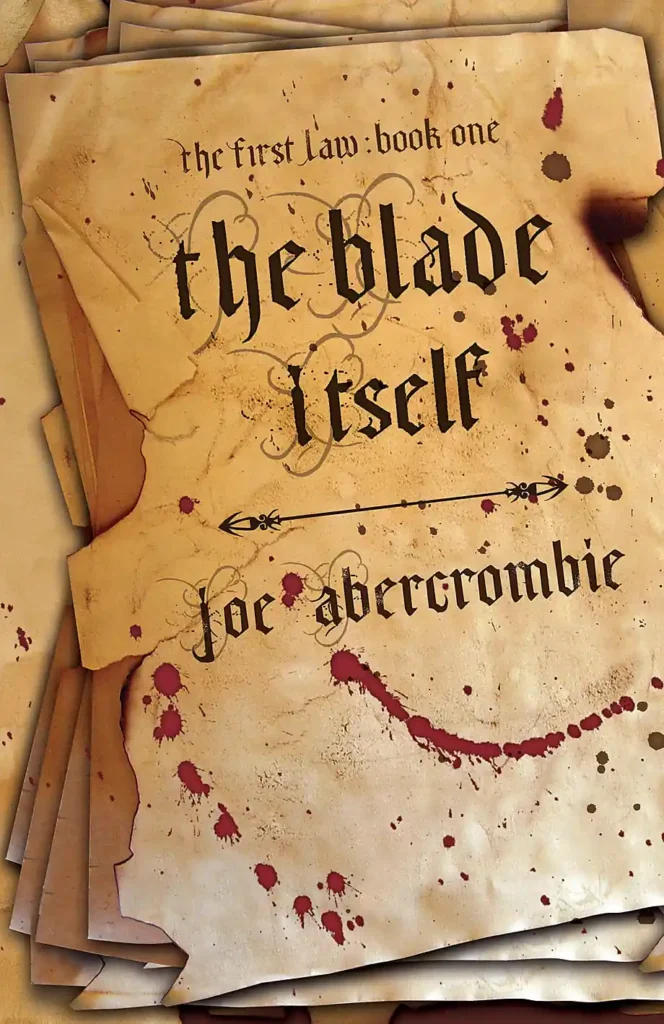
The Blade Itself by Joe Abercrombie: The Grimdark Debut That Makes You Root for People You Should Despise
| SUBJECT | Joe Abercrombie |
| PUBLISHED | THE BLADE ITSELF (PUBLISHED 2006) |
| RUNTIME | 21:03 |
| STATUS | CAN PEOPLE CHANGE? |
Joe Abercrombie published The Blade Itself in 2006, and it opened a series I somehow let sit on my shelf for the better part of two decades. I owned the whole First Law trilogy and the standalone novels since publication. I kept meaning to start, and never did, mostly because I had convinced myself nothing was going to top A Song of Ice and Fire.
People had been recommending it to me since it came out, and by some small miracle, I got to it without catching a single spoiler. So I went in clean, with no idea what I was holding. It turned out to be one of the best fantasy debuts I’ve ever read.
The Blade Itself flips the usual deal in epic fantasy. Most books in the genre hand you a plot first and give you characters to carry it. Abercrombie does the reverse, and he does it on purpose. He withholds almost any real plot, so the first book reads much closer to an extended prologue than a complete story, and he spends all of that room doing one thing instead: making you care about people you were built to despise. A torturer. A preening aristocrat. A feral, vengeance-driven woman. A killer with a body count he’s stopped keeping track of. By the last page, you’re rooting for at least one of them, probably all of them, and you’re not entirely sure how he pulled it off. None of that is a weakness in the book. Building those characters is the whole job the book set itself, and it’s the reason the pages keep turning when, strictly speaking, very little is happening.
A warning before we go any further: this is a full analysis of the whole novel, so I discuss every character turn and exactly where the first book leaves everyone. If you would rather stay unspoiled the way I did, my video review is the spoiler-free version. But, seriously, go read the book before even watching the spoiler-free version. It’s worth it.

A story that’s mostly setup, and knows it
The world runs on three fronts.
- At the center sits the Union, a proud, decaying kingdom ruled in practice by a Closed Council of old men, with a capital, Adua, that cares more about fencing tournaments and court gossip than the fact that it’s about to be attacked from two directions at once.
- To the north, a warlord named Bethod has crowned himself King of the Northmen and is turning toward the Union’s border.
- To the south, the Gurkish Empire and its prophet are gathering to do the same.
Inside all of that, three point-of-view threads barely touch across the entire novel: Logen Ninefingers up in the North, Glokta and Jezal down in Adua, and Bayaz, the First of the Magi, walking calmly into the middle of everyone’s business.
The honest thing to say is that almost nothing resolves. No war is won. No mystery fully closes. The one clear plotline, Bayaz quietly assembling a small group for a long journey to the far edge of the world, doesn’t even fire its starting gun until the final chapters. If you come to The Blade Itself expecting a tight, self-contained quest, you’ll spend a good chunk of it wondering when the story is going to start. The trick, and it took me a while to trust it, is that the waiting is the work. Abercrombie is using every one of those unhurried chapters to build the only thing he truly cares about, which is the people.
The three men you’re not supposed to like
Logen Ninefingers gets the first chapter, and it’s a good tell for the whole book. He opens it being hunted through the snow by Shanka (these balding humanoid gorilla creatures), goes over the edge of a gorge into a freezing river, and lives, while his old crew of Named Men back north give him up for dead.
This is the famous Bloody-Nine, a barbarian whose name gets spoken like a warning across the whole North. What Abercrombie does with him is the quiet tragedy of the novel. Logen wants, badly, to be a better man than his reputation. He keeps discovering that the better man isn’t the one who shows up when the killing starts.
His weary refrain, “you have to be realistic about these things,” is half survival wisdom and half a way of forgiving himself in advance. When the Bloody-Nine takes the wheel, Logen isn’t really there for it, and the gap between the tired, decent man and the thing he becomes in a fight is the engine of everything he does.
Then there’s Sand dan Glokta, who might be the most memorable character I’ve read in years. He used to be the Union’s golden boy, its champion swordsman, beautiful and arrogant and adored. The Gurkish captured him in the last war and spent two years taking him apart, and what came back can barely climb a staircase and works as an Inquisitor, doing to other people roughly what was once done to him.
Glokta’s chapters are written as a running interior monologue, and it’s the funniest, cruelest, most self-aware voice in the book. He despises the corrupt system he serves and serves it brilliantly anyway. In this first novel, his job is to break the Mercers, the merchants’ guild, on a charge of treason, which he does by working his way up a chain of terrified men from a wretch named Rews to their Magister. His reward is a promotion shaped like a death sentence: Arch Lector Sult ships him off to hold the doomed southern city of Dagoska against the coming Gurkish tide, which is exactly where the book leaves him. You’re supposed to hate a torturer. Instead, you find yourself waiting impatiently for his next chapter.
The third is Captain Jezal dan Luthar, and he’s the one Abercrombie hands you as bait. Jezal is a vain, lazy young officer who cares about winning at cards, looking good, and not much else. He spends the book training for the Contest, the kingdom’s grand fencing tournament, which he wins, and falling, first clumsily and then for real, for Ardee West, the sharp and poor sister of his friend Collem West. He’s the character you’re meant to roll your eyes at, and for most of the novel, you happily will. What Abercrombie sneaks in underneath is a handful of small cracks where something better keeps trying to show through. Then Bayaz picks Jezal for the long journey and hauls him out of the comfortable little life that’s the only thing he’s ever understood, and you realize the author has been quietly setting a hook in you the whole time.

The joke is the mechanism
People talk about Abercrombie’s dialogue, and it deserves the praise, but I think the humor is doing something more structural than making you laugh. Grimdark, as a mode, has a failure state. Pile on enough misery and violence with a straight face and the reader just goes numb, and once you’re numb you’ve stopped caring, which is the end of any book. Abercrombie almost never lets that happen, because his characters are funny. Glokta’s poisonous inner commentary, Logen’s exhausted one-liners, the banter among the Northmen who think Logen is dead, all of it keeps you sitting close to people you would cross the street to avoid in real life. And here is the sly part: once a torturer has made you laugh, you’ve already half forgiven him. The comedy is how Abercrombie smuggles your sympathy past your judgment before your judgment gets a vote. Most of the genre never learns that trick.
Bayaz, and who is actually pulling the strings
Hanging over all three men is Bayaz, the First of the Magi: bald, blunt, genial, and completely impossible to read. The novel keeps one question open through the whole story: whether Bayaz is a genuinely ancient and mighty wizard or simply a very good liar wearing the story of one.
He forces his way into the Union’s Closed Council on the strength of a claim older than the kingdom itself, and starts moving people around a board only he seems able to see: Logen, Jezal, an escaped Gurkish slave named Ferro Maljinn who gets steered toward him, and his own put-upon apprentice.
The magic stays mostly offstage and mostly ambiguous, and that restraint is a choice. By the closing chapters, Bayaz has gathered his little company, and they set out toward the far edge of the world, and you still can’t say for certain whether you’ve been watching a rescue or a long con. Holding that uncertainty open, and refusing to reassure you about the man steering the plot, is one of the smartest things the book does.
The real subject is whether people can change
Once you stand back, you can see what the first book is quietly pointing at. Every main character is circling the same question from a different side: Logen wants to stop being the Bloody-Nine and doesn’t know if a man can put that down; Glokta wonders, in his blackest moments, whether anything survives of the person he used to be, or whether the Gurkish killed that man and left the wreck to walk around; Jezal is handed his first genuine chance to become someone worth respecting, and has no idea what to do with it.
The whole trilogy, it turns out, is one long argument about whether people actually change or just circle their own nature until they die, and The Blade Itself is the book that makes you care enough to need the answer. That’s why the slow, plotless feeling of book one pays off so hard later. The introductions are doing real work. They’re the investment the sequels get to spend.
Why it matters that this is a debut
What still amazes me is that this is a first novel. The three voices are so distinct that by a third of the way in, you can name the point-of-view character from a single line of dialogue, which is a genuinely hard thing to do and something plenty of veteran writers never manage. The confidence it takes to withhold plot for four hundred pages and trust your characters to hold the reader is a masterstroke. Abercrombie worked as a freelance film editor before he wrote this, and you can feel it in the timing: the clean cuts between threads, the patience with a reveal, the way a joke lands one beat after a brutal moment so that the two sharpen each other. For a debut, it’s startlingly sure of what it wants to be and, just as importantly, what it refuses to be.

Read it, and stick with it
If you’re tired of fantasy where the heroes are clearly heroes, and the villains twirl their mustaches, start here. The Blade Itself gives you damaged, selfish, often frightening people and then dares you to care about them anyway, and it wins that dare almost every time.
My one piece of advice is the same one I got and ignored for years: if the first book feels slow, trust it and keep going, because those unhurried introductions are the foundation on which the next two books are built.
This is the novel that reset my expectations for the whole genre. Ever since I finished it, every fantasy series I’ve picked up has quietly been measured against it, and most of them come up short.
Have you read The Blade Itself? Did Logen, Glokta, or Jezal win you over, and which one did you least expect to root for? Tell me in the comments.
If you want to read about The First Law sequels, click the links below:
Read or hear The Blade Itself yourself
Mysterious Galaxies is a Libro.fm and Bookshop.org affiliate. If you buy the audiobook or the physical book through the links below, the channel earns a small commission at no extra cost to you.


Lit Escalates produced a special edition hardcover of the whole trilogy through Kickstarter, and this is the book whose dust jacket carries Logen on the cliff. I unboxed all three and went through the paper, the binding, and the damage that turned up in my box in my review of the Lit Escalates First Law set.
FAQs
What is The Blade Itself about?
The Blade Itself is a 2006 grimdark fantasy novel by Joe Abercrombie, the first book of the First Law trilogy. It follows three flawed men in a decaying kingdom on the edge of war: Logen Ninefingers, a weary barbarian with a fearsome reputation; Sand dan Glokta, a crippled ex-champion turned Inquisitor and torturer; and Jezal dan Luthar, a vain young officer. A mysterious wizard named Bayaz draws several of them together for a journey whose purpose only he understands. It’s less a self-contained plot than a character study that sets up the rest of the series.
Do I need to read The Blade Itself first?
Yes. It’s book one of the First Law trilogy, followed by Before They Are Hanged (2007) and Last Argument of Kings (2008). The trilogy is a single continuous story, and The Blade Itself introduces every major character and the shape of the world, so it’s the correct place to start. The later standalone novels and the Age of Madness trilogy are best read after the original three.
Is The Blade Itself grimdark, and how violent is it?
It’s one of the books that defined modern grimdark. Morality is deliberately murky, the heroes are compromised, and the violence is frequent and unglamorous, including battlefield killing and on-page torture drawn from Glokta’s work for the Inquisition. Abercrombie never plays the brutality for cheap shock, and he balances it with sharp dark humor, but it’s a book for adult readers who don’t need their fantasy tidy.
Why does it feel like nothing happens in the first book?
Because Abercrombie prioritizes character over plot on purpose. The Blade Itself works more like an extended prologue: it introduces the players, establishes the coming wars, and only sets its central quest in motion in the final chapters. If the pacing frustrates you early, that’s by design, and the payoff comes in the sequels, where all of those careful introductions start to matter. Trusting the slow build is the key to enjoying the trilogy.
Who are the main characters?
The three central point-of-view characters are Logen Ninefingers, an infamous Northern warrior known as the Bloody-Nine who is trying to leave his violent past behind; Sand dan Glokta, a former star swordsman left crippled by torture who now serves the Inquisition; and Jezal dan Luthar, a self-absorbed young captain chasing a fencing title and a woman named Ardee West. Circling all of them is Bayaz, the First of the Magi, whose motives stay hidden.
Is Bayaz a good guy or a villain?
The book deliberately refuses to tell you. Bayaz presents himself as an ancient and powerful wizard acting for the good of the Union, but Abercrombie keeps you wondering whether he’s exactly that or a masterful manipulator using everyone around him. By the end of The Blade Itself the question is still open, and it stays one of the most interesting threads running through the whole series.
Is the audiobook worth it?
Very much so. The First Law audiobooks are narrated by Steven Pacey, and his performance is the main reason I’d steer a new reader toward the audio. His distinct voices for Logen, Glokta, and the rest make the large cast easy to follow and bring out the humor beautifully. The unabridged recording of The Blade Itself runs a little over twenty-two hours and is available on Libro.fm through the link above.
What should I read next in the First Law world?
Continue straight into Before They Are Hanged and Last Argument of Kings to finish the original trilogy. After that, the standalone novels Best Served Cold, The Heroes, and Red Country return to the same world with overlapping characters, and the Age of Madness trilogy (beginning with A Little Hatred) jumps a generation forward. Reading them in publication order gives the fullest picture of Abercrombie’s world. If you’d rather see the whole thing argued as one story, that’s The First Law Trilogy, though it spoils all three books, so save it for afterward.
Sources
- The Blade Itself, Wikipedia (the 2006 publication, the three point-of-view characters, the Union and its wars, Bayaz, and the novel’s place in the First Law trilogy)
- Joe Abercrombie, Wikipedia (his background as a film editor, the First Law world, the standalone novels, and the Age of Madness trilogy)
- The Blade Itself, Hachette Book Group (the Orbit edition and the unabridged audiobook narrated by Steven Pacey)
SOURCE · Joe Abercrombie, The Blade Itself (published 2006). SERIES · The First Law.
Transmissions from ground control