▸ Book three of The First Law, and the finale that shows you the wires
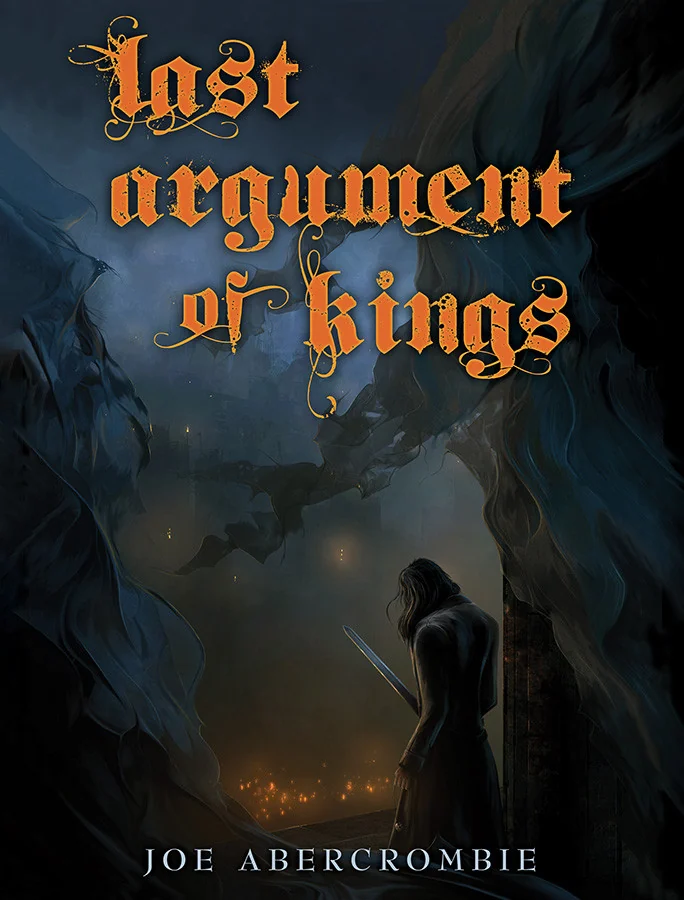
Last Argument of Kings by Joe Abercrombie: The Finale That Reveals the Whole Trilogy Was a Con
| SUBJECT | Joe Abercrombie |
| PUBLISHED | LAST ARGUMENT OF KINGS (PUBLISHED 2008) |
| RUNTIME | 14:43 |
| STATUS | THE CON REVEALED |
Joe Abercrombie published Last Argument of Kings in 2008, closing out the First Law trilogy two years after the debut and one year after Before They Are Hanged. I came to all three of them late, having let the books sit on my shelf for years, and by the time I opened this one I had stopped hedging about the series. The character work is a step above almost everything I’ve read recently. So I went into the finale expecting to be paid off, and I was, in a way I didn’t expect.
The Blade Itself asked whether people can change. Before They Are Hanged started answering, and the answer came at knifepoint. Last Argument of Kings finishes the answer by turning it around and showing you that the question was being manipulated the whole time. The quest you followed for a book and a half, the war that swallowed the North, the crown at the center of the Union, all of it was arranged, and the man doing the arranging has been standing in frame since chapter one with his hand out of shot. That’s why the ending divides people.
A warning before we go on: this is a full-spoiler analysis of the finale, which means I discuss every reveal, every fate, and exactly how the trilogy ends. The video review up top is the spoiler-free cut. If you haven’t finished the book, that version is the one you want, and I’ll see you back here afterward.

Everything comes home
Ultima ratio regum, the last argument of kings, was cast onto French cannon by order of Louis XIV, a line borrowed from Richelieu meaning that when talk runs out, artillery settles it. Abercrombie takes that as his heading for a book in which every character finally stops negotiating and finds out what actually decides things. The answer is almost never courage.
The threads that were flung apart across the middle book all come back to the same few rooms. Logen Ninefingers goes north, because Bethod’s war is burning across the country he ran away from and there’s exactly one man left who can stand in front of it.
Sand dan Glokta is back in Adua fighting a war with no battlefield, surrounded by enemies he can’t see, working with the only tools he has left, which are blackmail, debt, and pain.
Jezal dan Luthar comes home wanting nothing more than to be left alone with the woman he loves, having had ambition beaten out of him along with most of his face.
And the Union itself is coming apart on schedule: the king is dying, the Closed Council is circling the throne, the peasants are in open revolt, and the Gurkish are already moving. Nobody in Adua is looking at the sea.
What makes the convergence work is that Abercrombie has stopped introducing anything. Book one built the people, book two put them under load, and this one simply lets the machine run. There’s a real difference in the reading experience because of it. The first two books each had stretches where you could feel Abercrombie placing the setups. This one has none. The pace is the best in the series, though people tend to describe it wrong when they call it a relentless action ride. It works as a long tightening broken by carefully timed detonations, and once you’re anywhere near the last two hundred pages you’re not putting it down.
The twist that rewrites two books
About a third of the way in, Abercrombie detonates what you’ve come to expect. The peasant rising in the countryside needs putting down, and Jezal is sent out to do it. He does, gloriously and almost bloodlessly, and comes back a hero. Except the surrender had already been arranged before he arrived. The rebels were bought, the outcome was written, and the whole campaign existed to manufacture a public figure. The rising itself turns out to have been steered from behind for the same purpose. Jezal’s heroism is simply a stage production.
“I have learned all kinds of things from my many mistakes. The one thing I never learn is to stop making them.”
Then Bayaz stands up in front of the Open Council and announces that this newly minted hero is King Guslav’s hidden bastard, concealed for decades, and the vote that follows is a formality dressed as a democracy. Jezal is crowned. The arrogant fencer from book one, the punchline you were handed specifically so you would roll your eyes at him, ends the trilogy on the throne of the Union, and he is the least powerful person in the room he sits in.
The knife goes in later, when Bayaz tells him the parentage was invented too, that he was a child bought from a prostitute for six marks and raised into a useful shape. Whether that second version is true barely matters, and I think the ambiguity is the point. One of the two things Bayaz said is a lie, and either way Jezal’s entire identity, the noble blood he was insufferable about in book one and the royal blood he was handed in book three, was issued to him by a man who needed a puppet with a good jaw. Abercrombie spends three books teaching you to want Jezal to become someone, then reveals that becoming someone was the assignment all along.
This is the best twist I’ve read in fantasy short of A Song of Ice and Fire, and what makes it land is that none of it is smuggled in. Go back and the foreshadowing is sitting right there in the open, in Bayaz’s convenient arrivals and his interest in a mid-ranking officer nobody else could see the use of. What you feel is less disbelief than the far better sensation of wondering how you managed to miss it.
Bayaz, and the hand that was always on the board
Oh, Bayaz. How you feel about this trilogy probably comes down to how you feel about what Abercrombie does with him here, and he doesn’t do it in one stroke. He does it in layers, each one making the previous books look slightly worse in retrospect.
“You have to realistic about these things.”
The first layer is money. Valint and Balk, the bank whose debts have been quietly closing around Glokta’s throat since Dagoska, the institution that has been leaning on the Union from outside the story, belongs to Bayaz. He has owned the Union’s finances for centuries. Every political crisis you watched, every faction that seemed to be maneuvering on its own account, was operating inside a set of walls he built and charges rent on.
The second layer is history. When Bayaz finally gets into the House of the Maker, he meets Tolomei, the Maker’s daughter, and she tells the story of the founding differently than he has been telling it for three books. In her account the master he claims to have avenged, Juvens, died by Bayaz’s hand, and she herself was used and discarded to get him through that door the first time. Bayaz has a counter for it, as Bayaz always does. But the version of events that the entire magical backstory of the trilogy rests on is now a claim made by an interested party, and the reader is left holding two incompatible histories with no referee.
“Rules are for children. This is war, and in war the only crime is to lose.”
The third layer is the body count. The Seed, the relic the whole failed quest of book two was chasing, was in Adua the entire time. Bayaz retrieves it and uses it against the Gurkish in the middle of his own capital city, and the result reads far less like a triumphant magical rescue than like a detonation with a wizard’s name on it. The invading army is destroyed. So is a huge portion of Adua and the people living in it, and afterward a wasting sickness works its way through the survivors who were near the blast. Abercrombie takes the deus ex machina that fantasy has been promising since the first book and shows you the crater it leaves.
And underneath all of it sits the smallest, worst revelation. The Gurkish war, the thing that has consumed two nations and every character you care about, is a personal quarrel between two ancient men. Bayaz and the prophet Khalul have been feuding for centuries, and the Union, the Empire, Dagoska, the North, and everyone in them are ammunition. Nobody in this book dies for a cause. They die inside an argument they were never told about, which is the darkest possible reading of the title.
Logen goes home, and gets exactly as far as he started
The northern thread is the one that hurts, because it’s the one that briefly looks like it might pay off honestly. Logen goes back to the mud and the violence he has spent three books trying to outrun, and he does the thing everyone needs him to do. The Feared goes down, with Caurib’s sorcery broken by the crew around him. Bethod goes down after that, and Logen Ninefingers is declared King of the Northmen. On paper that’s the shape of a redemption: the man who ran comes home, kills the tyrant, and takes the crown.
Abercrombie holds it for about ten minutes. Black Dow, who has been at Logen’s shoulder for the entire trilogy, sets the trap in Carleon, and Logen understands with total clarity that he can’t win this one. So he does what he did on the first page of the first book. He goes out a window, into the water, and the book leaves him there. The final chapter is called The Beginning, and it’s written to rhyme so precisely with Logen’s opening escape in The Blade Itself that the trilogy closes into a loop.
“Sometimes it doesn’t matter too much what choice you make, as long as you make it quick and stick to it.”
That loop is the whole thesis stated in one image. Logen spends three books saying he wants to be a better man, and he means it every time. He also never stops being the Bloody-Nine, because the Bloody-Nine is what the world keeps needing from him, and the world is run by people who need it. His illusions get stripped off more completely than anyone else’s in the book. What looked for three books like a redemption arc closes into a circle, and Abercrombie was drawing it from the first page.
Glokta wins, which is the joke
If anything in this world qualifies as a happy ending, it belongs to the torturer, and Abercrombie clearly enjoyed arranging that. Glokta discovers that both of his Practicals have been selling him, decides the only way out is through, and goes after the Arch Lector himself. He gets Sult into a confession and then into a cell, and the crippled Superior who was shipped south to die in book two ends the trilogy as Arch Lector of his Majesty’s Inquisition. He also marries Ardee West, who is carrying Jezal’s child, which protects her from everyone who would find that pregnancy politically convenient to erase. For Glokta, that is practically tenderness.
“Truly, life is the misery we endure between disappointments.”
Then look at what he has actually won. He runs the Inquisition on Bayaz’s behalf, because the debts to Valint and Balk were never going to be forgiven, only transferred. He treats the people under him the way Sult treated him, without a flicker of the irony being lost on him. The most self-aware character in the series ends up occupying the exact chair he spent three books despising, with a leash he can describe in detail. His is still the most satisfying ending in the book for me, and the sting is part of why. It satisfies because Glokta finally gets what he has been clawing toward, and what he has been clawing toward turns out to be someone else’s furniture.
The bill, itemized
Collem West gets the redemption the series owed him. His conduct in The Blade Itself was ugly enough that some readers write him off permanently, and Abercrombie doesn’t ask you to forget it. He just puts West through two books of war and lets him become a commander worth following, promoted to Lord Marshal after Burr, competent and decent in a war run by neither. Then West is in Adua when the Seed goes off, and he dies slowly of the sickness that follows. He’s the clearest single example of what this book does: the man who earns the most gets nothing for it, because the thing that kills him was set off by someone who was never going to be told no.
Ferro Maljinn was the flattest of the leads through the first two books, and this is where she becomes one of the best things in the series. Her chapters carry some of the strongest writing in the trilogy. The Seed changes her permanently, she kills the Eater Mamun with what it left in her, and then she refuses the ending Abercrombie could have given her. She doesn’t get cured of her hatred and she doesn’t stay for the people who care about her. She goes south, alone, still hunting Khalul, and the book lets her leave without softening a thing. It’s ambiguous and it’s completely right.
The Dogman’s thread is the bleakest in a book with real competition for that title. He has lost more than anyone else across the trilogy, and by the end he is a chief because everyone who should have been one is back in the mud. Abercrombie gives him the most inward voice in the series, and what it keeps circling is that surviving has cost roughly what losing would have. He is left holding the North on Union sufferance, which is another way of saying Bayaz’s sufferance.
Why the ending makes people angry
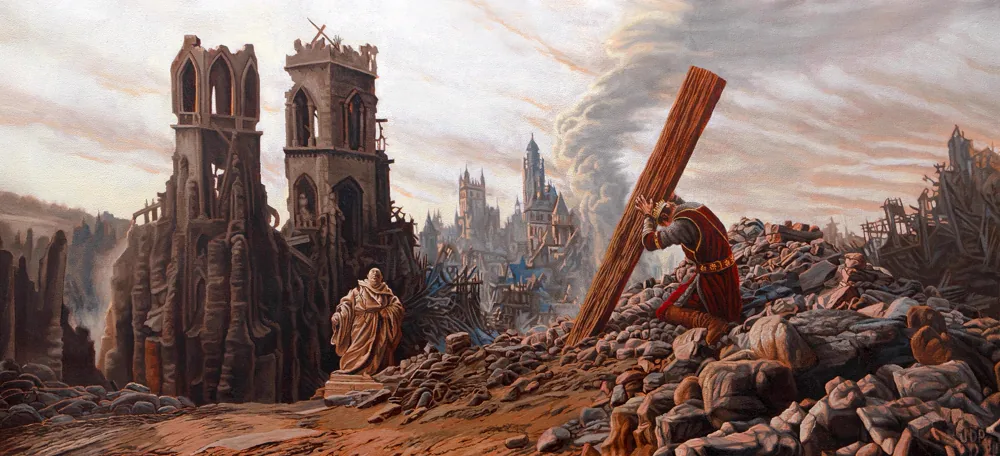
I can picture this ending genuinely infuriating a lot of readers, and I understand why. Epic fantasy runs on an unwritten contract: suffering buys transformation, the throne goes to the person who earned it, and the wizard who has been guiding the heroes is on their side. Abercrombie takes payment on all three and delivers none of them. The good guys don’t win, mostly because there are no good guys, only people with better and worse reasons.
My own reaction is ambivalence, and I want to be honest about that rather than talk myself into a tidier position. The ending isn’t conclusive. Threads are left dangling on purpose, Khalul is still out there, Ferro is walking south with a grudge, and Logen is in the water. Looking back at the trilogy I’m not sure why I expected otherwise, because the first two books both had endings I found less than stellar. This one absolutely works for me, but it’s also not for everyone, and anyone who tells you it is hasn’t met enough readers.
What keeps it on the right side of the line for me is that it’s earned rather than merely bleak, and the craft backs it up. There are a few things I love about this book: the climax lands roughly two thirds through, and Abercrombie refuses to cut away, spending the remaining pages on the human cost while a lesser structure would have rolled credits over the victory. He also ties off most of the mysteries he opened. The Eaters, the Seed, Valint and Balk, the Maker’s daughter, all of it gets answered, and the answers are worse than the questions. He just doesn’t hand over every card, and a few new questions go on the table on the way out.
The First Law, read as one book
Taken together, these three books are the most impactful character-driven story I’ve come across in twenty-five years of reading fantasy, and the reason is that Abercrombie never once flinched to make me comfortable. He built a torturer I root for, an arrogant fop I ended up mourning, and a killer whose worst self keeps saving everyone, and then he refused to let any of them be redeemed on schedule. That’s a harder trick than a good twist. It’s a writer taking massive risks with people readers have already paid to care about, and getting away with it because the characters were always the point and the plot was the delivery mechanism.
If you are a character-driven reader, this is a must-read, and I can see myself returning to it the way I return to A Song of Ice and Fire, The Lord of the Rings, and Harry Potter. If you need your fantasy to reward virtue, you already know this isn’t your series, and you probably knew it four hundred pages into book one. As for where to go next: the standalones come after this, Best Served Cold first, then The Heroes and Red Country, each returning to this world with characters you’ll recognize. After those, the Age of Madness trilogy starts with A Little Hatred and jumps a generation forward into the wreckage that Bayaz left running. Publication order gives you the fullest picture, and it also means you meet each consequence in the order Abercrombie designed it.
Last Argument of Kings made me question my assumptions about heroes and about endings, and it did it without a single cheap move. That’s why the trilogy keeps its place on my shelf, and why I am already looking at the standalones.
Have you finished The First Law? Did the ending land for you or did it feel like a betrayal, and where did you come down on Bayaz once you knew what he was? Tell me in the comments.
Read or hear Last Argument of Kings yourself
Mysterious Galaxies is a Libro.fm and Bookshop.org affiliate. If you buy the audiobook or the physical book through the links below, the channel earns a small commission at no extra cost to you.


The Lit Escalates special edition of the trilogy gives this book my favorite jacket of the three, and it’s also the volume that showed up with its endpapers coming away from the board. The full account is in my review of the Lit Escalates First Law set.
FAQs
What is Last Argument of Kings about?
Last Argument of Kings is a 2008 grimdark fantasy novel by Joe Abercrombie and the third and final book of the First Law trilogy. The Union is invaded by the Gurkish Empire while its king lies dying and its nobles fight over the succession, Logen Ninefingers returns north for a final reckoning with Bethod, Sand dan Glokta wages a secret war of blackmail and torture inside Adua, and Bayaz, the First of the Magi, moves everyone into position for a plan of his own. The title comes from ultima ratio regum, the last argument of kings, a motto Louis XIV had cast onto his cannon.
Do I need to read the first two books first?
Yes, and there is no way around it. This is the conclusion of one continuous story, and it assumes you know the entire cast and every thread left hanging. Start with The Blade Itself (2006), then Before They Are Hanged (2007), then this. Reading it cold would waste the best reveals in the series.
Why is the ending of Last Argument of Kings so divisive?
Because it refuses the payoff epic fantasy usually promises. Nobody is redeemed on schedule, the throne goes to a manufactured figurehead, the wizard who guided the heroes turns out to have been steering them for his own ends, and several threads are deliberately left open. Readers who want suffering to purchase transformation feel cheated. Readers who have been paying attention to what Abercrombie was arguing for three books tend to find it earned, if bleak. I land somewhere in between: it is not conclusive, but it is honest.
Is Bayaz the villain of The First Law?
He is the closest thing the trilogy has to one, though Abercrombie never lets him be that simple. By the end of this book Bayaz is revealed to own the bank Valint and Balk and through it much of the Union, to have manufactured a king, and to have set off a weapon that devastates his own capital along with the invading army. His account of his own history is contradicted by Tolomei in the House of the Maker. His war with the prophet Khalul, which has consumed two empires, is at bottom a personal feud between two very old men.
Does Logen Ninefingers die at the end?
Abercrombie does not say. After killing Bethod and being declared King of the Northmen, Logen is betrayed by Black Dow at Carleon and escapes out a window into the water below, and the book ends there. The final chapter is written to mirror his escape in the opening pages of The Blade Itself, where he also went into a river and survived. The ambiguity is doing thematic work, and the later books in the First Law world are where you go for more.
How long is Last Argument of Kings?
It is the longest book in the trilogy, running roughly 600 pages and about 234,000 words, first published by Gollancz in the UK on 20 March 2008 and available in the US in the Orbit edition. The unabridged audiobook from Hachette Audio runs about 27 hours.
Is the audiobook worth it?
Yes, and it is my recommendation for the whole trilogy. Steven Pacey narrates all three books, and his performance is the single best argument for taking these in audio. He gives Glokta, Logen, the Dogman, and the rest voices distinct enough to keep a very large cast straight, and he lands Abercrombie’s humor better than most readers will in their heads. The unabridged recording is on Libro.fm through the link above.
What should I read next after finishing The First Law?
Continue in publication order. The standalone novels come next, starting with Best Served Cold, then The Heroes and Red Country, all set in the same world with characters carried over from the trilogy. After those, the Age of Madness trilogy begins with A Little Hatred (2019) and moves a generation forward into the consequences of everything Bayaz set up here. The short story collection Sharp Ends fills in gaps along the way. And if you want the trilogy argued as one story, with what the three books add up to and where Ferro ends up, that’s The First Law Trilogy.
Sources
- Last Argument of Kings, Hachette Book Group (the Orbit print edition and the unabridged audiobook narrated by Steven Pacey)
- Canon de 24 de Valliere, Wikipedia (the motto ultima ratio regum, the last argument of kings, cast onto French cannon under Louis XIV)
SOURCE · Joe Abercrombie, Last Argument of Kings (published 2008). SERIES · The First Law.
Transmissions from ground control