▸ The dystopia that doesn't need a boot on your neck, only a pill you're glad to take
Brave New World by Aldous Huxley: Great Book, Mediocre Novel
| SUBJECT | Aldous Huxley |
| PUBLISHED | BRAVE NEW WORLD (PUBLISHED 1932) |
| RUNTIME | 26:18 |
| STATUS | EVERYBODY'S HAPPY NOW |
Aldous Huxley published Brave New World in February 1932, and it was a huge part of my teenage years. I finally got around to rereading it, which is something I’d been meaning to do for a long time, and I came away with a split verdict I want to lay out honestly rather than smooth over.
Here it is up front. Brave New World contains one of the best arguments anybody has ever made in fiction about what we’d be willing to trade our humanity for. It’s also, for long stretches, a fairly weak novel. Huxley set out to write a case rather than a story, and the finished book keeps the shape of the thing he set out to write. The characters serve positions. The plot exists to walk the debate forward. And it has outlived almost everything published alongside it anyway, because the case he was making turned out to describe us better than it described anyone in 1932.
So that’s the review. Now let me show my work.
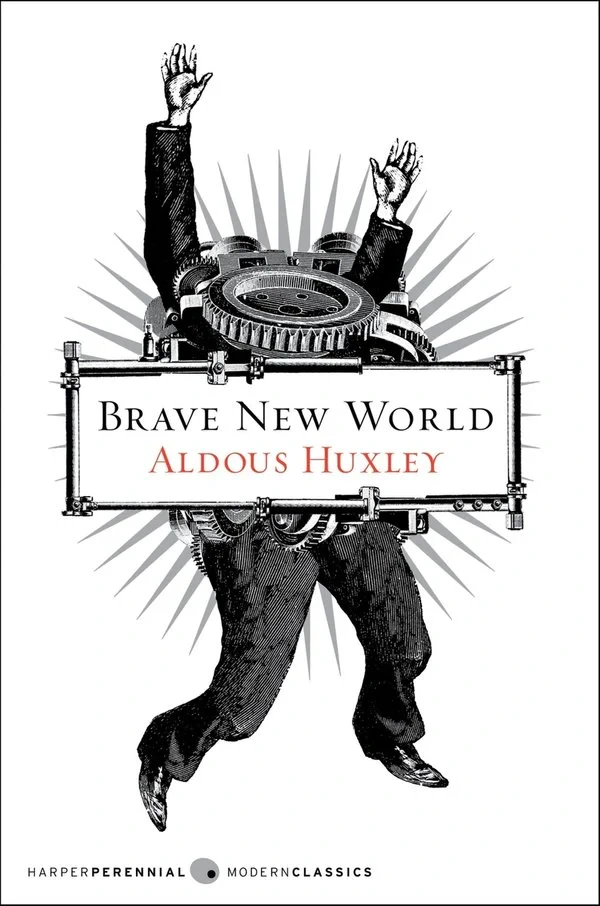
Huxley wrote it in four months, partly to make fun of H.G. Wells
The making-of matters more than usual here, because it explains why the book behaves the way it does.
Huxley wrote Brave New World in four months, from May to August 1931, while he was living at Sanary-sur-Mer on the French Mediterranean coast. Chatto and Windus published it the following February. It was his fifth novel and his first dystopia, and he arrived at it after a decade of satires that poked at the absurdities of the English chattering class.
The starting point was a joke at somebody else’s expense. Huxley had H.G. Wells on the brain, specifically the utopian novels where science and rational planning deliver a clean, orderly, contented future, and he wanted to needle them. He wrote in a letter that he’d been having a little fun pulling the leg of H.G. Wells. The World State begins life as a send-up. Here’s your rational future. Here’s your perfectly planned society. Here’s what it would actually feel like from the inside.
Somewhere in those four months the joke got away from him and became the thing he’s remembered for. But the parody is still down there in the foundations, and I think it accounts for nearly every strength and every weakness in the finished book. A parody exists to argue with something. It’s engineered to score points against an idea. That instinct never leaves Brave New World, even after it grows into something far colder and far more serious than a leg-pull.
Two other details are worth knowing. The title comes from The Tempest, Act V, where Miranda lays eyes on other human beings for the first time and marvels at the brave new world that has such people in it. Huxley’s Savage quotes her twice, once in wonder and later in horror, and those two readings of the same line are the entire book in miniature. And the epigraph comes from the Russian philosopher Nikolai Berdyaev rather than from any novelist, printed in the book as Nicolas Berdiaeff, a passage in French asking how we might avoid the final realisation of utopia. Huxley put a philosophical question on the front door. That tells you what kind of book you’ve picked up.
What Brave New World is about
The year is A.F. 632. That’s After Ford, six centuries and change since the Model T, and Henry Ford has been promoted to deity. People cross themselves with a T. The World State’s motto, stamped over the door of the Central London Hatchery and Conditioning Centre, reads Community, Identity, Stability.
Nobody is born. Embryos are decanted from bottles on a conveyor, and the lower castes are budded through Bokanovsky’s Process so that a single egg yields up to ninety-six identical humans. Everyone is sorted before decanting into one of five castes, Alpha down through Beta, Gamma, Delta, and Epsilon, and then chemically shaped to fit. Alphas get oxygen and room to grow. Epsilons get less of both, on purpose, because a society running on identical twins working identical machines is a society that never argues with itself.
The conditioning starts immediately and never really stops. Infants are given electric shocks near books and flowers so they’ll grow up hating both. Children are taught in their sleep, a process Huxley calls hypnopaedia, with slogans repeated tens of thousands of times until they come out sounding like the child’s own opinions. Ending is better than mending. Everybody belongs to everybody else. Sixty-two thousand four hundred repetitions make one truth, as Bernard Marx thinks bitterly, and he’s the closest thing the World State has to a dissident.
All of this rests on a war. The Nine Years’ War, beginning in A.F. 141, was fought with anthrax bombs and a shopping list of nerve agents that Huxley names with disturbing specificity. What came out the other side was a civilisation that had decided permanent stability was worth any price at all, and then quietly paid it. History was abolished. Museums closed, monuments demolished, every book published before A.F. 150 suppressed.
What’s left is managed pleasure. Sex is recreational, compulsory in spirit, and detached from reproduction entirely. Entertainment comes as the feelies, cinema you can touch. And when any of it slips, there’s soma, a drug with no hangover and no cost, dispensed at the end of every shift. The state doesn’t have to suppress unhappiness because it has arranged for unhappiness to be chemically optional.
Into this drop two men who don’t fit. Bernard Marx is an Alpha who came out slightly wrong and knows it, resentful and lonely and convinced he’s better than the people around him. And John, raised on a Savage Reservation in New Mexico by a World State woman who got stranded there pregnant, comes back to London with nothing in his head but Shakespeare and the mother-love the World State bred out of itself. John’s father, as it happens, is the Director of the Hatchery, which is the kind of coincidence a book uses when it needs a lever rather than a life.
The dystopia that doesn’t need a boot
This is the part that earns the book its permanent place, and it’s worth being precise about what Huxley actually pulled off.
Most totalitarian fiction runs on fear. There’s a regime, it hurts people who step out of line, and the horror is legible because we recognise the machinery of a prison. Huxley built something harder to argue with. His World State has almost no police. It doesn’t need them. It has arranged for its citizens to want precisely what it plans to give them, and it starts arranging that before they’re decanted.
A citizen of the World State is free in the sense we usually mean. Nobody’s stopping them. They can have any partner they like, take any amount of soma, watch anything at the feelies. The cage is on the inside, built out of preferences that were installed rather than chosen, and it holds better than bars because nobody in it experiences it as a cage. Mustapha Mond, the World Controller who gets the book’s best lines, puts it flatly at one point: people believe things because they’ve been conditioned to believe them.
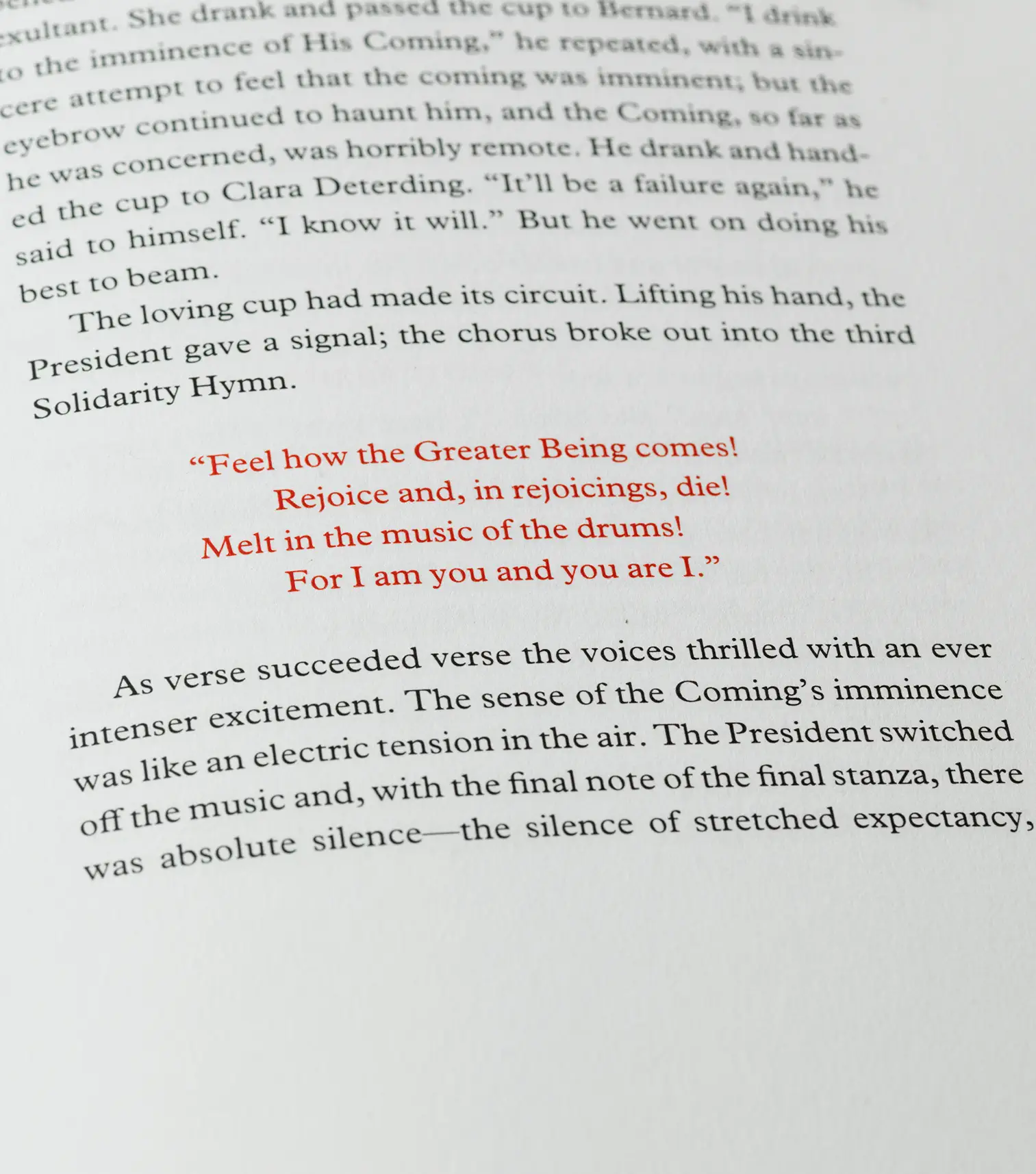
The clearest picture of it is the Solidarity Service, a sacrament the World State runs in place of religion. Twelve people, a circle, soma dissolved in a loving cup passed hand to hand, and a hymn sung to a synthetic orchestra while everyone works themselves toward a collective ecstasy. Bernard sits through it faking every response and feeling more alone at the end than he did at the start. Huxley understood that a society which cancels loneliness by decree will produce a specific new kind of loneliness, and that the people it lands on won’t have the vocabulary to name it.
And Huxley refuses to let you off the hook by making it ugly. That’s the move I’d missed as a teenager. The World State works. Nobody’s hungry, nobody’s sick, nobody’s frightened, nobody grows old in any way that shows. Everybody’s happy now, as the citizens repeat, having heard it a hundred and fifty times a night for twelve years. If you want to reject it you have to reject a genuinely functional society on grounds you’ll struggle to make sound like anything other than sentiment. Huxley knew that, and he wrote the book so you’d have to do the work yourself.
Where the novel gives out
Now the other half of the verdict, because I don’t think this book is the masterpiece it’s often filed as, and the reasons are worth being specific about.
Take Bernard Marx. He arrives loaded with promise. He’s an Alpha who doesn’t enjoy what he’s supposed to enjoy, he’s physically smaller than his caste should be, and he carries the sort of grievance that curdles into insight if you give it somewhere to go. For sixty pages he looks like the spine of the novel.
Then Huxley does something genuinely sharp with him and immediately drops it. The moment Bernard brings John back from the Reservation and becomes a social celebrity, his principles evaporate. He starts hosting parties. He enjoys the women who suddenly find him interesting. His rebellion turns out to have been resentment about his own low status, and it dissolves the second his status improves. That’s a real and unflattering observation about dissent, and it’s the best character work in the book.
Huxley then loses interest. Bernard spends the back half whining, grovelling, and being carried along by events, and he’s finally shipped off to an island with a few lines of dialogue and no reckoning. The book proved something about him and then couldn’t be bothered to finish the person.
John has the opposite problem. He’s given everything a protagonist needs, a childhood of exclusion and violence on the Reservation, a mother he loves and is ashamed of, a head full of borrowed Elizabethan language he uses because he has nothing else. And he still comes across as a delivery system for a position. When John reacts to the World State, he reacts the way the argument requires at that moment rather than the way a specific damaged young man would. His horror at Lenina is presented as the natural revulsion of an uncorrupted soul, when what’s actually on the page is a man who has fused desire and disgust because of how he grew up. That’s a far more interesting character, and Huxley isn’t quite writing him.
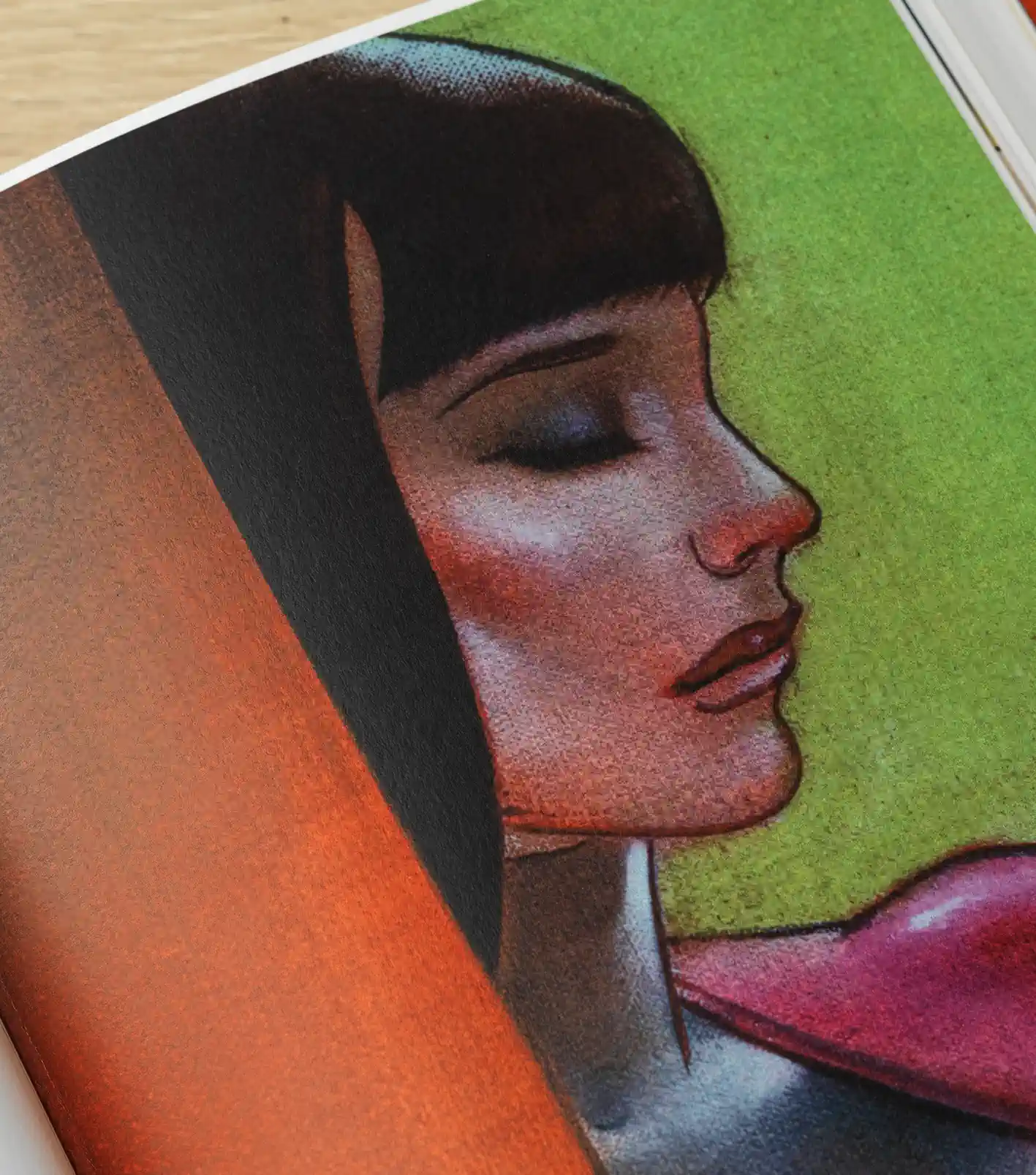
Lenina Crowne is the clearest case. She’s the one character with an obvious arc available to her. She develops something for John that her conditioning has left her no words for, she pursues it, she gets called terrible things and eventually gets hurt for it, and the book treats her throughout as a specimen. The word attached to her is pneumatic, which is how the men around her describe her body, and Huxley never quite steps outside their view of her. A novelist interested in Lenina would have found the story of a woman discovering an emotion her society deleted. Huxley had that story sitting right there and used her as evidence instead.
There’s also a structural oddity worth flagging. Chapter three cuts between three conversations, splicing them line by line until they interleave into a single stream of propaganda, gossip, and history. It’s the most formally ambitious thing in the book and it works. Huxley never does it again. That’s the pattern throughout: real novelistic ability, deployed in bursts, subordinated to the argument whenever the two compete.
The one chapter where the argument becomes drama
Then you reach chapter seventeen, and everything I’ve just complained about stops mattering for about twenty pages.
John and Mustapha Mond are alone in a room. Mond is not a fool and not a fanatic. He’s a former physicist who was caught doing real science, was offered exile or a Controller’s chair, and took the chair. He keeps forbidden books in a safe. He has read the arguments against his own civilisation more carefully than John has, and he agrees with more of them than John expects. He explains, without apology, what the World State traded away and why: art, science, religion, and God, sacrificed deliberately in exchange for a stability nobody has to be brave to survive.
And when John finally makes his stand, it lands as the best line in the book because Mond has spent the chapter earning it. John refuses comfort and demands God, poetry, real danger, freedom, goodness, and sin. Mond, unbothered, translates it for him: he’s claiming the right to be unhappy. John accepts the terms and claims it anyway.
That exchange works because both men are right. Mond has the better argument about outcomes, and he knows exactly what his society costs. John has the better argument about what a person is for, and he can’t defend it in Mond’s language because Mond’s language was built to make it unsayable. The scene is Huxley at full strength, and I’d note what it actually is. It’s two positions in a room, talking. The novel is at its best in the one chapter that gives up on being a novel and admits it’s a debate.
What follows is bleak and, to Huxley’s credit, unsentimental. John retreats to a lighthouse to punish himself back into a person, the crowds come to watch him do it, he’s filmed, and the spectacle finishes him. The last image is a pair of feet, hanging in a doorway, turning slowly like compass needles, first one way and then the other. It’s a superb closing shot. It’s also the closest the book comes to admitting that its own protagonist had nowhere to go from the moment he stepped off the plane.
What Huxley got right, and what he didn’t
People reach for the word prophetic with this book, usually while pointing at test-tube babies or antidepressants. I’d rather be careful, because the surface predictions are the least impressive thing about it.
Plenty of the hardware is wrong or beside the point. The rigid five-caste system with its bottled Epsilons has no real analogue. The eugenics is period-specific and reads now like what it was, a 1931 preoccupation Huxley shared with a lot of his class. The World State’s centralised control is closer to the century Huxley was living through than the one we’re in.
What he got right is the mechanism, and the mechanism is the whole point. Huxley’s claim was that a sufficiently comfortable society doesn’t need to censor anything, because it can simply make the alternative unattractive. You don’t ban the difficult book. You make sure there’s always something easier within arm’s reach, and you let attention do the rest. Nobody in the World State is forbidden from reading Shakespeare. They just have the feelies, and Shakespeare is work.
Sit with that for a second and it stops being about 1932. A feed engineered to be marginally more interesting than whatever you meant to do instead is Huxley’s mechanism with better tooling. Soma is any of the several things people reach for at the end of a bad day specifically so the day stops registering. And the hypnopaedic slogan, a short phrase repeated until it feels like your own conclusion, is a functioning description of how opinions now move through a network.
I want to be fair about the limits. Huxley didn’t predict surveillance, and he wasn’t trying to. He didn’t foresee that the pleasant version and the coercive version would turn out to be compatible, running in the same country at the same time on different populations. And a book that thinks the alternative to engineered comfort is a young man flogging himself at a lighthouse hasn’t fully worked out what it’s arguing for. Huxley himself said as much later, and in the 1946 foreword he admitted the novel gave John only insanity or the Reservation as options and offered him nothing in between.
What survives is the question, and it’s a harder one than the boot-on-the-face dystopias ask. Those want to know whether you’d resist a regime that hurt you. Huxley wants to know whether you’d notice a regime that never did. If you want the other great prophetic dystopia written by someone who saw the mechanism rather than the hardware, Parable of the Sower is the one I’d hand you next.
So should you read it?
Yes, with your expectations set correctly.
Go in expecting a gripping character-driven novel and you’ll spend the middle third wondering why nobody in it seems to want anything. The people are thin, the plot is a delivery mechanism, and the emotional temperature stays low almost to the end. Those are real problems and I’m not going to pretend the book’s reputation dissolves them.
Go in knowing you’re reading a brilliant argument that happens to be shaped like a story, and it’s one of the most useful books in the genre. It’s short, around sixty-five thousand words, so it costs you an afternoon or two. It’s funnier than its reputation suggests, especially early, when the parody of Wells is still visible. And chapter seventeen alone justifies the trip.
My honest bottom line: it’s a great book and a mediocre novel, and the fact that it’s still being argued about ninety-four years later settles which of those two matters more.
Where do you land on it? Is the flatness of the characters a flaw, or is it doing something a warmer book couldn’t do in a world that manufactures people? And which dystopia do you think described us better, Huxley’s or Orwell’s? Tell me in the comments.
Read or hear Brave New World yourself
Mysterious Galaxies is a Libro.fm and Bookshop.org affiliate. If you buy the audiobook or the paperback through the links below, the channel earns a small commission at no extra cost to you.
The audiobook

The paperback

FAQs
What is Brave New World about?
Brave New World is a 1932 dystopian novel by Aldous Huxley, set in a world state six hundred years in the future where humans are mass-produced in bottles, sorted into five castes before birth, and conditioned in their sleep to love the lives they’ve been assigned. Unhappiness is managed with a drug called soma. The story follows Bernard Marx, an Alpha who doesn’t fit, and John, a young man raised outside the system on a Savage Reservation, whose arrival in London forces the civilisation to explain itself.
Is Brave New World worth reading?
Yes, as long as you know what you’re getting. It’s around sixty-five thousand words, so it’s a short read, and the ideas in it are as sharp as anything in the genre. The characters are thin and the plot is functional, which is a real limitation rather than a matter of taste. If you want a novel that moves you through people, this will frustrate you. If you want an argument about freedom and comfort that you’ll still be chewing on weeks later, it’s essential.
Why are the characters in Brave New World so flat?
Because Huxley set out to write an argument. The book began as a parody of H.G. Wells’s utopian novels, and it kept that structure as it grew into something more serious: each major figure represents a position on the question of whether engineered happiness is worth what it costs. Bernard is the resentment that mistakes itself for principle, John is the unconditioned human, Mustapha Mond is the system’s best defence of itself. Huxley shows real ability with Bernard early on and then abandons it whenever character and argument compete.
What is soma in Brave New World?
Soma is the World State’s government-issued drug, handed out at the end of every working day. It produces contentment with no hangover and no lasting cost, and citizens take it whenever anything unpleasant threatens to register. It matters to the book’s argument because it’s the tool that makes coercion unnecessary. A population that can chemically opt out of its own discomfort never builds up the pressure that leads to asking questions.
What does the title Brave New World mean?
It comes from Shakespeare’s The Tempest, Act V, where Miranda, who has grown up seeing almost no other people, marvels at the brave new world that has such people in it. Huxley’s John quotes the line twice: first in genuine wonder when he’s invited to London, and later in disgust once he’s seen what the place is. The two readings of one line carry the book’s argument.
Which was more accurate, Brave New World or 1984?
They describe two different mechanisms and both are in use. Orwell wrote about control through fear, surveillance, and pain, which is an accurate picture of a number of governments operating today. Huxley wrote about control through pleasure, distraction, and manufactured consent, which describes the wealthy democracies more closely. Huxley’s specific hardware was often wrong, since he predicted neither surveillance nor networks. His mechanism, that people can be made to love the thing that limits them, has held up unusually well.
What is hypnopaedia in Brave New World?
Hypnopaedia is sleep-teaching, the World State’s method of moral conditioning. Children hear short slogans repeated while they sleep, thousands of times over several years, until the phrases surface later as their own convictions. Examples in the novel include “ending is better than mending,” which keeps consumption high, and the line about everybody belonging to everybody else, which dissolves attachment. Huxley’s point is that it doesn’t teach people what to think so much as remove the possibility of thinking otherwise.
How does Brave New World end?
Spoilers for a ninety-four-year-old novel. After his mother’s death and a failed attempt to start a riot, John is brought before World Controller Mustapha Mond, who explains what the World State gave up for stability and offers no apology for it. Bernard and his friend Helmholtz are exiled to islands. John retreats alone to an abandoned lighthouse and tries to purify himself through fasting and self-flagellation, but reporters and then crowds arrive to watch, the spectacle turns into an orgy of soma and violence, and John hangs himself. The final image is his feet turning slowly in a doorway.
Why was Brave New World banned?
Ireland banned it in 1932, the year it was published, over its treatment of religion and its casual attitude to sex and drugs, and Australia banned it the same year for roughly five years. In the United States it’s been challenged repeatedly in public schools on similar grounds, and it sits on the American Library Association’s list of the hundred most frequently challenged books of 1990 to 2000. The irony is not subtle: a novel about a society that suppresses inconvenient books has spent most of a century being suppressed.
Where should I start with Aldous Huxley?
Start here. Brave New World is his most important book and the shortest route into what he cared about. After that, Brave New World Revisited (1958) is a book-length essay in which Huxley reassesses his own predictions and decides, gloomily, that he was closer than he’d hoped. The Doors of Perception (1954) is his account of taking mescaline and is worth reading for the prose, and it’s where the rock band The Doors got their name. Huxley published nearly fifty books and was nominated for the Nobel Prize in Literature nine times.
Sources
- Brave New World, Wikipedia (composition at Sanary-sur-Mer between May and August 1931, Chatto and Windus publication in February 1932, the Wells parody and Huxley’s “pulling the leg” letter, the Tempest title source)
- Aldous Huxley, Wikipedia (nine Nobel Prize in Literature nominations, the 1911 eye illness, the LSD request on 22 November 1963)
- Brave New World, Areté Editions (the letterpress edition photographed above: art by Allen Jones, printed by Hand & Eye, bound by Ludlow Bookbinders, thirty copies in the Roman state and 225 numbered)
- Brave New World, National Archives of Australia (the Australian ban imposed in 1932)
- Brave New World, HarperCollins (the Harper Perennial Modern Classics paperback, ISBN 9780060850524)
- Aldous Huxley, Foreword to the 1946 edition of Brave New World (where Huxley calls it the book’s most serious defect that the Savage is offered only two alternatives, and says he would give him a third if he rewrote it)
SOURCE · Aldous Huxley, Brave New World (published 1932).
Transmissions from ground control