▸ Essay
The Long Walk: Every Big Change the Movie Made to Stephen King’s Book
| FILED | JULY 8, 2026 |
| SUBJECT | Stephen King |
| SECTION | Adaptations |
Francis Lawrence’s 2025 film of The Long Walk is the leanest, meanest Stephen King adaptation in years, and it gets there by making real changes to the book. Some are practical, the kind any adaptation has to make to fit a 1979 novel into a hundred and eight minutes. Others reshape who these boys are and what their deaths mean. A few flip the story’s whole argument on its head. If you’ve read Stephen King‘s first novel and walked out of the theater wondering what got moved, cut, or rebuilt, here’s the full accounting.
A warning before we start: this covers the entire story, including both endings. If you haven’t finished the book or seen the film and want to stay unspoiled, step off here. For a closer read of the novel on its own terms, see my deep dive on The Long Walk as a book. And if you’d rather just watch the video version of this breakdown, it’s right above.
Garraty walks for a different reason
In the book, Ray Garraty can’t really say why he signed up. Like most of the boys, he’s chasing something he can’t name: the prize, the prestige, an escape from a small life. King leaves the motive vague on purpose because the not-knowing is the horror. These kids volunteer for their own destruction and can’t even tell you what for.
Book Garraty does carry a wound. He remembers his father being taken away for speaking against the government, and there’s an old memory of his dad bringing him as a child to watch the Walk, a warning against the whole rotten system. Then the boy grows up and enters the exact nightmare his father tried to inoculate him against. But it stays subtext. Garraty never sees his father killed, and the Major, a remote national figure, would never be doing that kind of dirty work himself in small-town Maine.
The film makes it personal and literal. Cooper Hoffman’s Garraty watched the Major execute his father in the street, and now he walks for revenge. He wants to get close enough to the man who did it to make him pay. It gives the character a harder edge and a clearer engine, and it pays off later when he sees his mother in the crowd, and you understand exactly what his obsession is costing. The book is about a boy who can’t explain himself. The movie is about a boy who thinks he can, and is wrong about what it will do to him.

Jan is gone, and his mother takes her place
This looks like a small change, but it shifts the story’s emotional center. In the novel, Garraty has a girlfriend, Jan, and they never break up. She begged him to back out when he “won” the lottery, and she stands by him anyway. As the miles grind on, Garraty stops seeing Jan as a person and turns her into a symbol, a pure thing to hold onto while he’s knee-deep in horror. When he finally spots her in the crowd at Freeport, he ignores his own mother, who’s standing right there, and collapses into Jan’s arms. It takes McVries physically hauling him back to keep him from being shot on the spot.
The film cuts Jan entirely. Garraty and his girlfriend broke up before the Walk, and that’s the end of it. The person waiting in the crowd is his mother. Suddenly the stakes have shifted from teenage romance to a son realizing what his hunger for revenge is doing to the one person who loves him without condition. First love feels like the end of the world until it isn’t. A mother’s love is the bond that shaped you before you knew what love was, and putting her in Jan’s place cuts the scene closer to the bone.
Scramm never makes it into the movie
One of the book’s most affecting boys is Scramm, a plainspoken, gap-toothed kid from the Midwest and the strongest walker on the road. The Vegas oddsmakers make him the favorite. Then he catches a cold that turns into pneumonia, and he lets himself go after the others promise to look after his family. And that family is the point: Scramm is the only married one, with a pregnant wife back home, walking toward death to provide for a child he’ll never meet. While the other boys talk about girls, he talks about his wife.
The film doesn’t have Scramm at all. Instead it splits his pieces among the others. Hank Olson gets a wife back home. The illness and the role of favorite-brought-low get folded into other walkers. Consolidating characters is a reasonable way to keep an ensemble legible on screen, but losing that specific thread, a man walking to his death to feed an unborn child, costs the story one of its quietest gut-punches.
Olson’s death is even worse on the page
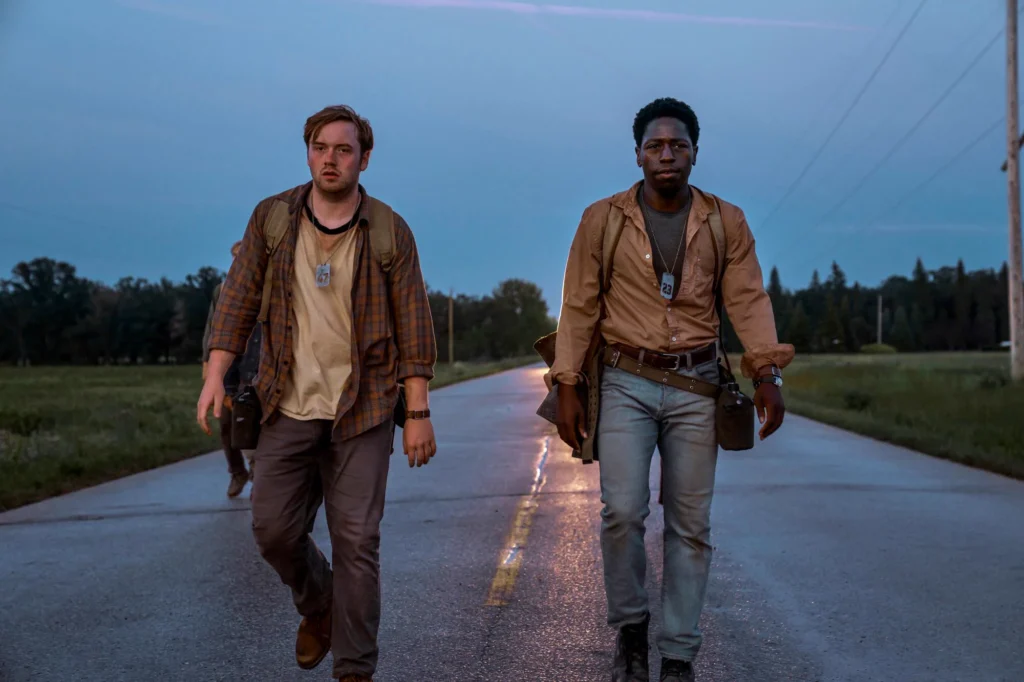
Hank Olson’s death in the movie is already brutal. He snaps, goes at the soldiers, gets shot, and bleeds out on the road as a lesson to everyone still walking. King took it further. In the book, Olson doesn’t just fall. He gets shot and keeps walking with his intestines hanging out of him, staggering forward as he comes apart, taking round after round until he finally goes down, and then one more shot to be sure. It’s one of the most horrifying passages King ever wrote, and it’s easy to see why the film pulled it back. Some things land harder on the page than they ever could on screen.
Stebbins dies a different death
Stebbins is compelling in both versions: the Major’s illegitimate son, walking to force his father to acknowledge him. His end is where they part. In the novel, after Scramm dies he becomes the boy no one can wear down, and near the finish, when it’s just him and Garraty, he explains that the Major deliberately kept him at a distance to make him the “rabbit,” the pacesetter the others chase, the way a mechanical hare pulls the dogs around a greyhound track. He’s the last to fall, clawing at Garraty before he drops.
The film gives him a version of Scramm’s death instead. He gets sick, reveals who his father is, offers Garraty and the others some parting advice, and lets himself go. It’s slower and more sentimental than the cold machinery of the book’s version. Different, not worse, but it trades Stebbins’s chilling final revelation for something warmer.
McVries was far crueler in the book
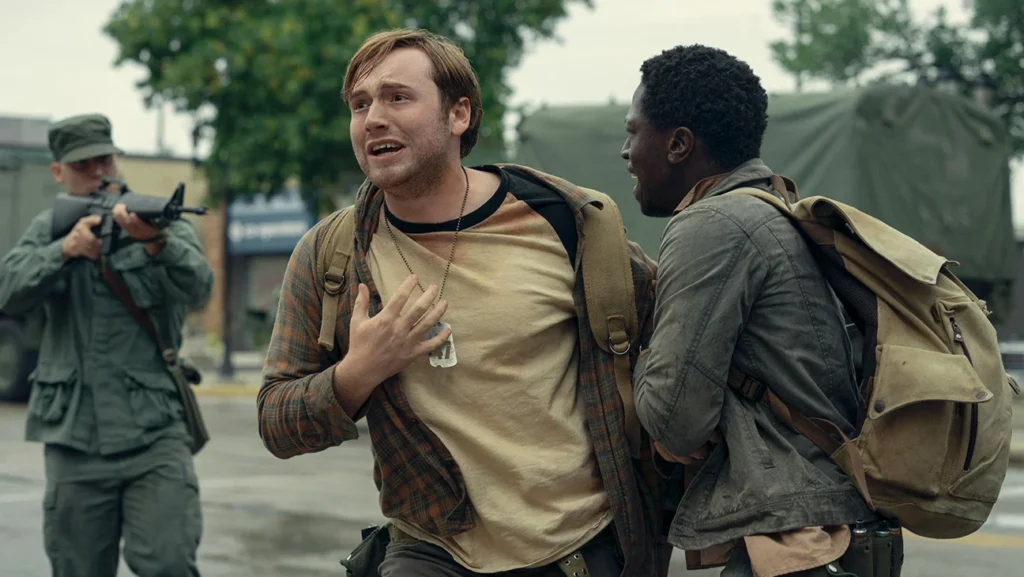
Here’s a change that flips how you feel about a character. On screen, Peter McVries, played by David Jonsson, is a little snarky but deeply decent, the friend you’d want beside you in a hell like this. The film eventually reveals that his charm was built over a lifetime of loneliness: an orphan who got his scar in a fight with a stranger, who learned to make fast, real connections and spent his teens sleeping on couches and in basements. He never quite says it, but you sense he joined the Walk for the belonging it offered, and that he finds a genuine brother in Garraty, maybe something more.
Book McVries is sharper and colder, quicker with a cutting remark. And his scar has a much darker origin. He got it from a girl named Priscilla, after an encounter he describes as a kiss she read as an assault, cutting him with a letter opener to protect herself. King keeps it deliberately murky. It’s McVries’s account, and the self-loathing underneath it makes you read between the lines. He admits that ever since, he’s carried a death wish, one he suspects every boy on the Walk shares in some form. The movie rewrites all of that into something more sympathetic and leans harder into the queer subtext King already had on the page. It makes McVries easier to love without sanding off his edge.
The no-help pact bites harder in the book
Both versions have the survivors agree to stop helping one another as the end nears, every man for himself. The book takes the vow seriously, and it kills people. In the film, the trio of Garraty, McVries, and Baker abandons the promise the moment one of them starts to fade. In the novel they hold to it, and it’s devastating: boys who might have been saved are left to die because of a rule they imposed on themselves. There’s a walker named Abraham, absent from the film, who proposes the pact and then pays for it when no one will give up a shirt to keep him warm overnight. He catches a chill, falls behind, and it’s a hard little lesson in how good intentions turn into weapons.


The practical changes: pace, numbers, and crowds
A cluster of smaller changes exists mostly for expediency, and they’re worth grouping together.
The pace dropped from four miles an hour to three, and this one came from King himself. It was the only note he gave the producers on the script. Decades on, with a treadmill in every gym, he decided the original speed was unrealistic, that there’s no way you could hold four miles an hour for that long. Three is closer to a normal walking pace, which also lets the actors carry on the deep conversations about life and death that the story runs on, instead of half-jogging through every scene.
The field shrank from one hundred boys to fifty. Fifty extras cost less than a hundred, and a smaller cast is far easier to keep straight on screen. The film also assigns each walker a home state, which is tidier than the book, where Garraty just happens to be the local Maine kid, and the state-by-state framing fits the dystopian, nationalized feel of the whole thing.
The crowds are gone. In the novel the boys pass cheering spectators in every town, because in that America watching children die is peak entertainment, and the crowd is the story’s quiet accusation. The film says public gatherings are banned. That reads like a budget decision, but the emptier, more isolated world it creates turns out to feel more ominous, not less.
A handful of other beats fell away too: Olson’s early psychological warfare against the other boys, a subplot about a mother trying to reach her son from the roadside before the government arrests her, and a walker killed at the worst possible moment for being aroused. That’s adaptation. You can’t fit every strand of King’s paranoia into under two hours, and most of these cuts just get out of the story’s way.

The ending: two very different kinds of hopeless
The biggest change is the ending, and it’s really several changes at once.
King’s finale is the kind of literary gut-shot that separates great horror from the rest. The final two aren’t Garraty and McVries. McVries sits down and takes his bullet with something close to peace, tired of the whole game.
That leaves Garraty and Stebbins, and Stebbins, for all his endurance, simply collapses dead from exhaustion, his body giving out like a broken machine. Garraty wins. The Major comes to shake his hand, and Garraty doesn’t even see him. He’s staring past the old man at a dark figure up ahead on the road, beckoning him forward, and he keeps walking toward it.
King never tells you what it is. Death, the ghosts of everyone he watched die, his own shattered mind, all of it at once. The line that closes the book, “There was still so far to walk,” leaves the horror open like a question you can’t stop asking. Nobody wins this game. Even the last boy standing keeps walking, because the Walk moves from your feet into your head and marches there forever.
The film trades the poetry for a blow to the chest. Garraty stops walking on the fifth day, after roughly three hundred and thirty miles, and the Major executes him. But this time, the boy who came to kill the Major gives up rather than outlast his friend, and McVries is the one left alive. He doesn’t take his prize and disappear. He takes a soldier’s rifle and puts a round through the Major on live television, then turns and walks off down the empty street, almost certainly to die within minutes. (An alternate ending exists in which he spares the Major, and money is quietly mailed to the dead boys’ families instead.)
On the surface, it’s crowd-pleasing, the villain finally getting what’s coming. Dig in, and it’s just as bleak as King’s version, maybe bleaker. But it’s also more subversive.
King’s ending is sophisticated and perfectly matched to its nihilistic 1970s roots, and it’s ultimately defeatist: live or die, you always lose. The film’s McVries probably doesn’t outlast book Garraty by much, yet he does something the novel never allows. He kills a symbol of oppression in front of everyone, and he does it out of love for his friend rather than hate. That’s a transgressive note that feels startlingly current, the idea that one act of love-driven rebellion might crack the foundation of a system built to grind you down, even if you don’t live to see what grows from the rubble. It falls short of hope, but it’s something the book refuses to give you.
So which one is better?
Neither, really, and that’s the honest answer. Most of the practical changes serve the film without hurting the story. The character surgery is a wash: you lose Scramm and the crueler McVries, you gain a sharper Garraty and a mother who wrecks you. The endings are the real fork in the road. King’s is a nihilist’s masterpiece that says the game can’t be won. The movie’s says the game can’t be won either, but you can still spit in its eye on the way out.
If you want the definitive version of the novel’s argument, it’s still the book, and it’s worth reading alongside the rest of the early King run, from Carrie to Rage to The Stand. If you want a version that finally lets one of these boys fight back, Francis Lawrence made it for you.
Did you read the book before you saw the film, or go in blind? Tell me which ending landed harder in the comments.
Read or hear The Long Walk yourself
Mysterious Galaxies is a Libro.fm and Bookshop.org affiliate. If you buy the audiobook or physical book through the links below, the channel earns a small commission at no extra cost to you.


FAQs
Is the Long Walk movie faithful to the book?
Mostly, yes. Francis Lawrence’s 2025 film keeps the core premise intact: teenage boys volunteer for a state-run walking contest, hold a minimum pace or die, and only one survives. Most of the changes are practical (fewer walkers, a slower pace, no crowds) or consolidate characters for the screen. The one place it breaks sharply from King is the ending, which the film rewrites almost completely. So it’s a faithful adaptation of the setup and spirit, with a deliberately different finish.
How does the Long Walk movie ending differ from the book?
In the novel, Garraty is the last boy walking. He wins, then sees a dark figure beckoning him down the road and keeps walking toward it, with no explanation of what it is. In the film, Garraty stops on the fifth day and the Major executes him, leaving Peter McVries as the survivor. Rather than accept his prize, McVries takes a soldier’s rifle and kills the Major on live television, then walks off into the empty street to die. An alternate ending has him spare the Major instead. The book ends in poetic hopelessness; the film ends in an act of rebellion.
Why did they change the walking speed in the Long Walk movie?
Stephen King asked them to. It was the only note he gave the producers on the script. In the novel the walkers have to keep four miles per hour, but King decided decades later that the figure was unrealistic, that no one could sustain four miles an hour for days on end, especially now that treadmills have made everyone aware of how fast that is. So the film lowered it to three miles per hour, closer to a normal walking pace, which also let the actors hold conversations instead of half-jogging through their scenes.
Why is there no girlfriend in the Long Walk movie?
The novel gives Garraty a girlfriend, Jan, whom he idealizes as the pure thing worth surviving for, and reuniting with her in the crowd is one of the book’s key scenes. The film cuts Jan and has the couple break up before the Walk. In her place, it puts Garraty’s mother in the crowd, which shifts the emotional stakes from teenage romance to the unconditional bond between a mother and the son who’s throwing his life away for revenge.
What happened to Scramm in the Long Walk movie?
Scramm isn’t in the film. In the book he’s the strong, married walker with a pregnant wife back home, the betting favorite who dies of pneumonia after the others promise to care for his family. The movie removes him and distributes his traits among other characters, giving Hank Olson a wife at home and folding the illness and the favorite-brought-low arc into the remaining walkers. It’s a common adaptation move, but it costs the story one of its most quietly devastating threads.
How many walkers are in the Long Walk movie compared to the book?
The novel starts with one hundred boys; the film cuts that to fifty. The smaller number is cheaper to stage and far easier to keep track of on screen. The movie also assigns each walker a home state, which is tidier than the book’s version, where Garraty simply happens to be the local Maine boy, and the state-by-state framing fits the film’s nationalized, dystopian tone.
Does the Major die in the Long Walk movie?
Yes, in the main ending. After Garraty stops walking and is executed, the surviving walker, Peter McVries, takes a soldier’s rifle and shoots the Major dead on live television before walking away. This never happens in the book, where the Major is untouchable and the story ends with Garraty following a mysterious dark figure down the road. The film also shot an alternate ending in which the Major is spared.
Is McVries different in the movie than in the book?
Very. Book McVries is cutting and cold, carrying a death wish and a disturbing backstory: his scar comes from a girl who cut him with a letter opener during an encounter he describes, ambiguously, as a kiss she took for an assault. The film reinvents him as a warmer, more sympathetic orphan who learned to charm his way into belonging, gives his scar a different origin, and leans further into the queer subtext already present in King’s version. He’s more likable on screen without losing his edge.
Does the Long Walk movie have crowds like the book?
No. In the novel, cheering spectators line the route through every town, and that watching crowd is one of King’s central accusations about a society that treats children’s deaths as entertainment. The film bans public gatherings, so the boys walk through a mostly empty, silent world. It reads partly as a budget decision, but the emptier world ends up feeling more ominous rather than less.
Which ending is better, the book or the movie?
It depends on what you want. King’s ending is a nihilist masterpiece: Garraty wins but keeps walking toward a dark figure only he can see, and the message is that no one ever really wins the game. The film’s ending is bleaker on its surface but more defiant underneath, letting McVries kill the Major out of love for his friend, a small act of rebellion the book never permits. The novel is the purer statement of its own argument; the film is the one that finally lets a boy fight back.
Who is in the cast of the Long Walk movie?
The 2025 film is directed by Francis Lawrence and stars Cooper Hoffman as Ray Garraty, David Jonsson as Peter McVries, and Mark Hamill as the Major. The supporting walkers include Charlie Plummer as Gary Barkovitch, Garrett Wareing as Stebbins, Tut Nyuot as Arthur Baker, and Ben Wang as Hank Olson. It was released by Lionsgate on September 12, 2025.
Sources
- SlashFilm, “Stephen King Had One Condition For The Long Walk Movie” (King’s note to reduce the pace from four to three miles per hour, via producer Roy Lee)
Transmissions from ground control