▸ The man who came back from death, and brought the emptiness with him
Lazarus by Leonid Andreyev: What the Man Jesus Raised Saw Is Worse Than Death
| SUBJECT | Leonid Andreyev |
| PUBLISHED | "LAZARUS" (PUBLISHED 1906) |
| RUNTIME | 31:17 |
| STATUS | DO NOT MEET HIS GAZE |
In the Gospel of John, the raising of Lazarus is the happy ending to end all happy endings. A man is four days dead, his sisters are grieving, Jesus weeps, and then he calls Lazarus out of the tomb alive. Christians have read it for two thousand years as proof that death doesn’t get the last word.
In 1906 the Russian writer Leonid Andreyev asked what happened after that. His “Lazarus” picks up at the welcome-home party and follows the man for the rest of his second life. He comes back bloated and blue. He never says what he saw. And anyone who looks into his eyes loses the will to live.
Here’s my verdict up front. This is one of the great early works of cosmic horror, written twenty years before H.P. Lovecraft made the idea famous, and it’s the bleakest thing I’ve covered on this site. The story lines up every defense people have against death, one at a time, and knocks each one down. One defense almost holds, and I think it’s the key to the whole story. My reservations are small: the middle stretch reads a bit like a sermon, and I’ll get to that.
A note before we go on: this is a full-spoiler review, ending included, and the video above covers the same ground. The story is short and free to read online (links at the bottom), so if you want to meet it cold, now’s the time.
“If death itself had appeared men would not have feared it so much; for hitherto death had been known to the dead only, and life to the living only, and between these two there had been no bridge. But this strange being knew death, and that knowledge of his was felt to be mysterious and cursed.”
The writer who tried to frighten Tolstoy
Andreyev was born in Oryol, Russia, in 1871. He studied law in Moscow and Saint Petersburg and worked as a court reporter for a Moscow paper, and one of his early stories, “Bargamot and Garaska,” caught the eye of Maxim Gorky, who told him to take his fiction seriously. Within a few years he was one of the most famous writers in Russia, known for dark, feverish work like The Red Laugh (1904), about the madness of war, and later The Seven Who Were Hanged (1908) and the play He Who Gets Slapped (1915). In the introduction to his English translation of that play, Gregory Zilboorg quotes Leo Tolstoy’s verdict on the younger man: “Leonid Andreyev tries to frighten me, but I am not afraid.” Tolstoy got off easy. The rest of us have “Lazarus.”
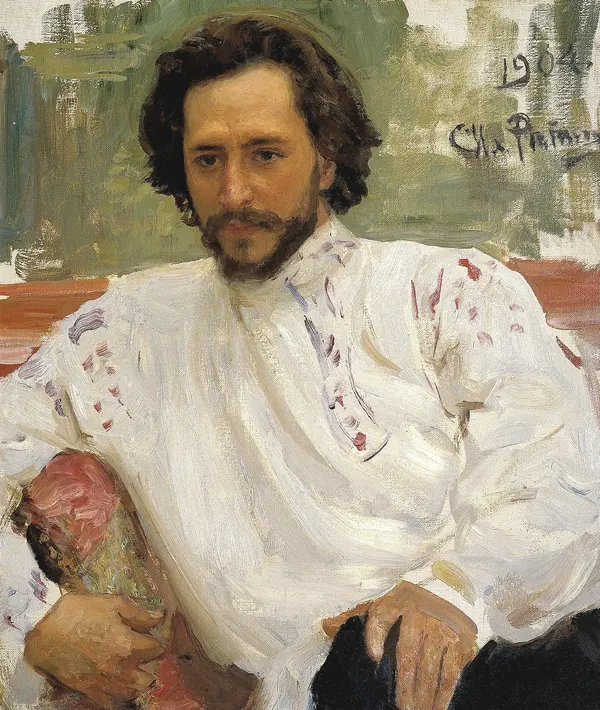
He wrote it in 1906, the year after Russia’s failed 1905 revolution, under the title “Eleazar.” It was a hard year for him personally, too: his wife, Alexandra, died that year of an infection after childbirth. The story reached English quickly. An anonymous translation ran in the American magazine Current Literature in May 1907, and Abraham Yarmolinsky published a second one in 1918. This page quotes the 1907 version, which is the one I read for the video.
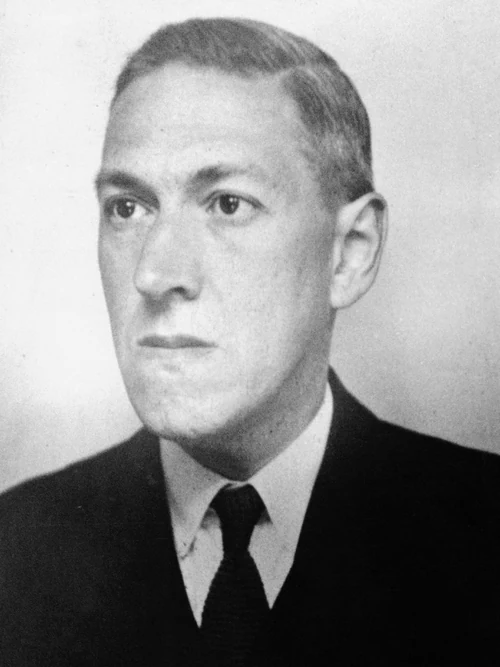
In March 1927 the story ran in Weird Tales, the pulp magazine that published Lovecraft’s own fiction, and Lovecraft, who owned copies of The Red Laugh and The Seven Who Were Hanged, had the chance to read it there. You can feel why it would land with him. The terror in “Lazarus” comes from knowledge too large for a human mind, and from a universe that doesn’t care, with no monster or curse anywhere in it.
What “Lazarus” is about
Lazarus has been dead for three days and three nights, the same span Jesus will spend in his own tomb (John’s Gospel says four). Now he’s home, and his sisters, Mary and Martha, throw him a feast, with musicians and new clothes fit for a bridegroom. Neighbors come to see the miracle, then strangers from far-off towns. Jesus is never named in the story. He’s only ever “the Master.”
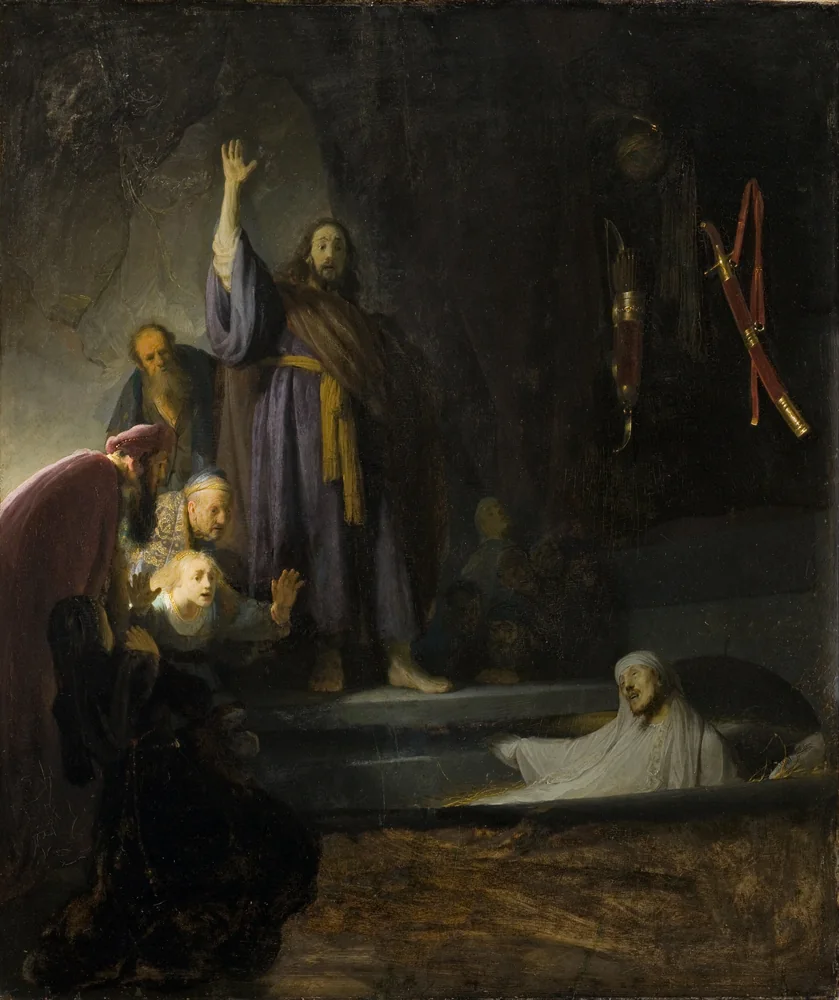
Then someone at the party asks what everyone has been avoiding: what was it like, on the other side? Lazarus doesn’t answer. He just looks at them, and his look turns out to be a kind of contagion. The people it touches lose interest in everything and fade into slow deaths. His family leaves him. His town shuns him. People come from far away to test themselves against him and go home broken, including a celebrated Roman sculptor. Finally the emperor Augustus summons him to Rome, and the most powerful man in the world looks Lazarus in the eye.
The man who came back wrong
As Stephen King warned us, sometimes dead is better. Andreyev makes sure you see the body before anyone at the party is willing to:
“On his temples, under his eyes, and in the hollow of his cheek lay a thick, earthy blue. His fingers were blue, too, and under his nails, which had grown long in the grave, the blue had turned livid. Here and there on his lips and body, the skin, blistered in the grave, had burst open and left reddish glistening cracks, as if covered with a thin, glassy slime. And he had grown exceedingly stout. His body was horribly bloated and suggested the fetid, damp smell of putrefaction.”

His family decides it’s the aftereffect of a grave illness, and they make a point of not looking too closely. The change goes deeper than skin. Before he died, Lazarus was cheerful and fond of a joke, and it was his good humor that made him “so beloved by the Master.” Now he barely speaks, and when he does it’s in “words as much devoid of sense and depth as are the sounds with which an animal expresses pain and pleasure, thirst and hunger.” The miracle brought back his body and left a large piece of him behind.
Then a guest asks the question: “Why do you not tell us, Lazarus, what was There?” The music dies out instrument by instrument. And Lazarus lifts his eyes.
“He looked quiet and simple. One felt that he had no intention to hide anything, but also no intention to tell anything. His look was cold, as of one who is entirely indifferent to all that is alive. . . . the men thus stricken by the gaze of Lazarus began to fade away listlessly and quietly and pass into a slow death lasting many long years. They died in the presence of everybody, colourless, haggard and gloomy, like trees withering on rocky ground.”
What strikes me is that there’s no malice in him. He has no wish to hide anything or to hurt anyone. He just knows something, and the knowledge leaks out through his eyes. His sisters leave him one at a time; Martha holds out longest, because she can’t bear the thought of no one nursing him, until one windy night she slips away too. The town treats him like a leper. Someone suggests tying a bell around his neck so nobody bumps into him by accident, and the plan is dropped because “it would be terrible if at night, under the windows, one should happen to hear Lazarus’ bell.”
“The particles of the particles became lonely”
Lazarus himself never tells anyone what he saw. The only description in the story comes secondhand, from the few people who survived his look and could still bring themselves to talk:
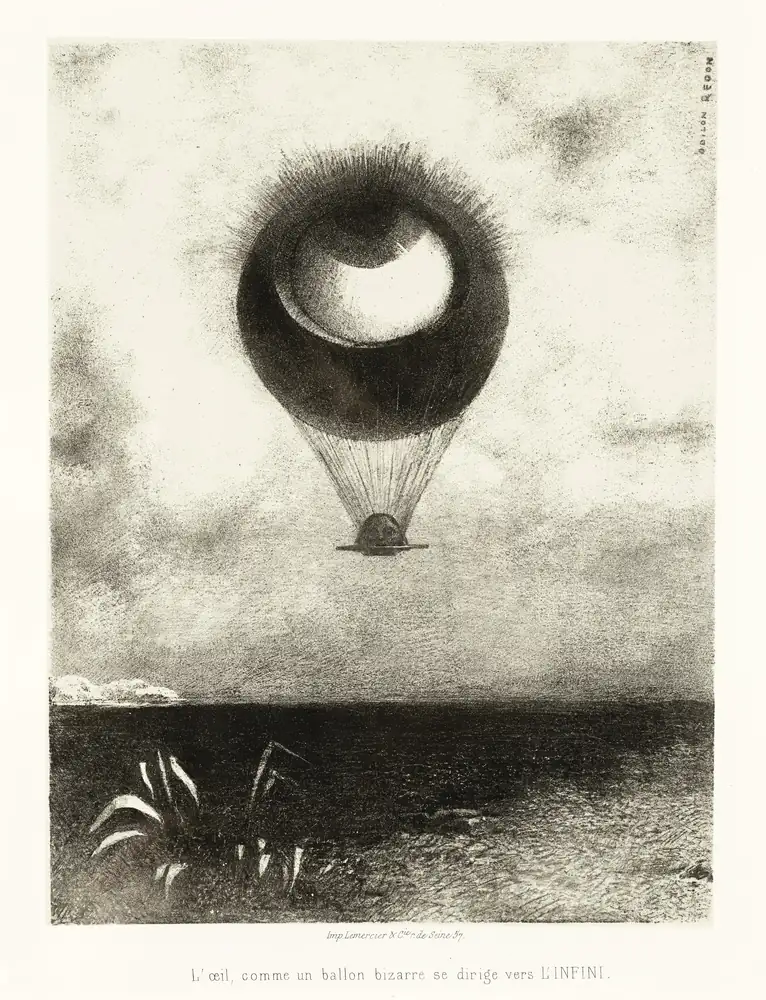
“Into all bodies it penetrated, even into iron and stone; and the particles of the body lost their unity and became lonely. Even to the heart of the particles it penetrated, and the particles of the particles became lonely.
“. . . There was no more a sense of time; the beginning of all things and their end merged into one. In the very moment when a building was being erected and one could hear the builders striking with their hammers, one seemed already to see its ruins, and then emptiness where the ruins were.
“A man was just born, and funeral candles were already lighted at his head, and then were extinguished; and soon there was emptiness where before had been the man and the candles.”
Notice what’s missing. Nobody mentions fire, or demons, or judgment. Nobody mentions paradise either. What they describe is emptiness, a void that gets into everything and separates everything from everything else, down to the smallest piece of matter. Loneliness all the way down. That’s what makes it cosmic horror rather than religious horror: the afterlife Lazarus brings back holds no punishment and no reward, only the sight of how small and brief everything is.
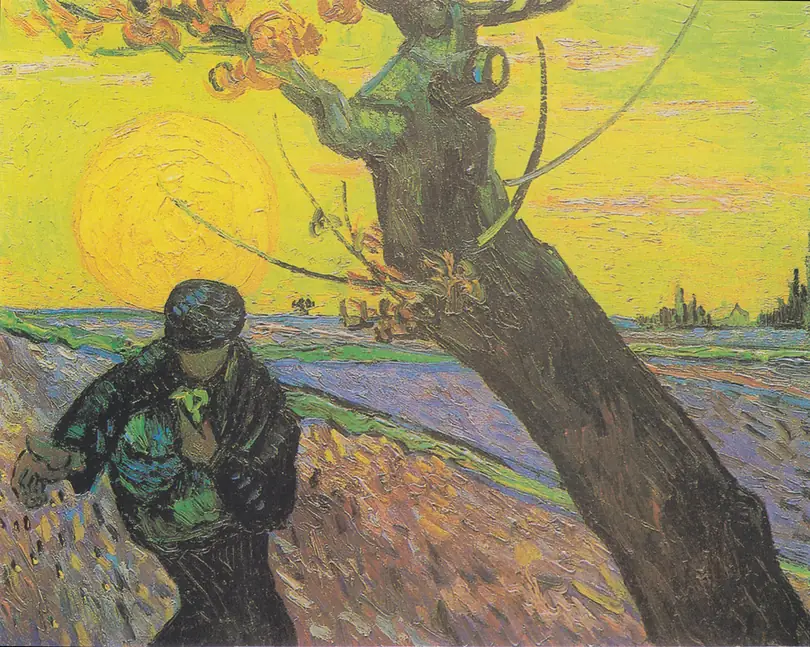
And yet he seems to want something. He sits in the sun every day, his wedding clothes rotting on him, and when someone asks whether he finds it pleasant, he says, “Yes, it is pleasant.” It’s the only time in the story he admits to liking anything. Every evening he walks out into the desert straight toward the setting sun, “as though intending to reach it.”
A gauntlet of defenses
From here the story becomes a series of tests. Each visitor brings something people use to hold death at bay, and each one walks away with it broken.
The first is art. Aurelius is a famous Roman sculptor whose statues people call immortal, but he isn’t satisfied with them: “There is no soul in my marble, there is no life in my beautiful bronze.” He comes to Judea curious, not afraid, and he’s charming about it. “It is true you are not beautiful, my poor Lazarus,” he says. “You are even frightful, my poor friend.” He stays the night. As the dark comes on, his chatter starts to fray, and by full dark he’s begging for “just a small light.” He goes home to Rome, makes one more sculpture, and unveils it:
“It was a thing monstrous, possessing none of the forms familiar to the eye, yet not devoid of a hint of some new unknown form. On a thin tortuous little branch, or rather an ugly likeness of one, lay crooked, strange, unsightly, shapeless heaps of something turned outside in, or something turned inside out. . . . And, accidentally, under one of the wild projections, they noticed a wonderfully sculptured butterfly, with transparent wings, trembling as though with a weak longing to fly.”
The friend who loves him best smashes it with two hammer blows and leaves only the butterfly. I think that statue is the closest the story comes to showing us what Lazarus saw: something formless that the eye can’t hold, with one small fragile thing in it still trying to fly. Aurelius never makes anything again. When his friends take him to see other artists’ work, he listens to their talk of beauty and dismisses all of it as a lie.

Then Lazarus is called to Rome, and while the emperor puts off the meeting, three more challengers take their turns. A cheerful drunkard toasts him, “Drink, Lazarus, drink!”, and afterward is drunk forever without drinking, “shadowed by fearful dreams.” A young couple asks, “Is there anything stronger than love?” They go on loving each other their whole lives, but “their love became mournful and gloomy.” And a proud sage announces that he already knows every horror Lazarus could show him, until he learns “that the knowledge of the horrible is not the horrible, and that the sight of death is not death,” and grabs his head crying, “I cannot think!”
Pleasure, love, and wisdom all fall within a week. It sounds like a sermon on the deadly sins, except that the story never judges any of them. The sage learns that in the eyes of the Infinite “wisdom and folly are the same.” Something that can’t tell wisdom from folly can’t tell virtue from vice either.
The emperor of the living
Before Lazarus meets Augustus, the court gives him a makeover. Barbers and painters work on him all night, curling his beard, whitening his hands, and painting over his face:
“The disgusting wrinkles of suffering that ridged his old face were patched up and painted, and on the smooth surface, wrinkles of good-nature and laughter, and of pleasant, good-humoured cheeriness, were laid on artistically with fine brushes.”
They’ve painted back the cheerful Lazarus the Master loved. “But the wedding-dress they did not dare to take off; and they could not change his eyes.” It’s the most Roman thing in the story: you can’t fix what’s wrong, so you make it presentable.
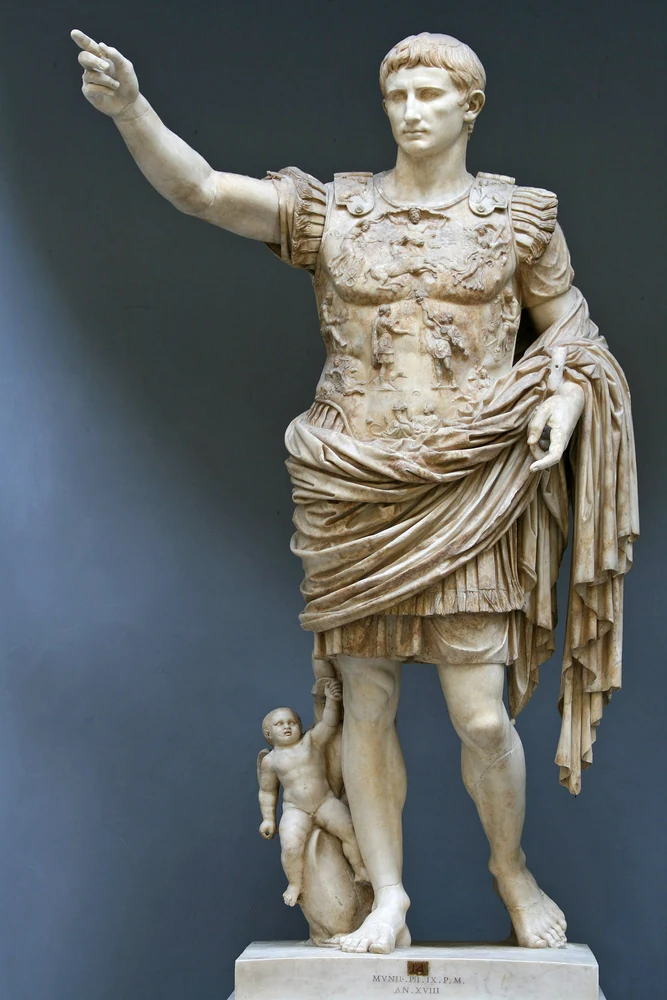
Augustus asks him who he is, and twice Lazarus gives the same answer: “I was dead.” The emperor’s reply sums up his whole worldview:
“My empire is an empire of the living; my people are a people of the living and not of the dead. You are superfluous here. I do not know who you are, I do not know what you have seen There, but if you lie, I hate your lies, and if you tell the truth, I hate your truth.”
Then, to prove he isn’t afraid, he orders Lazarus to look at him. At first the gaze is gentle, a promise of “quiet rest,” with the Infinite like “a fond mistress, a compassionate sister, a mother.” Then iron closes around him, and the vision opens:
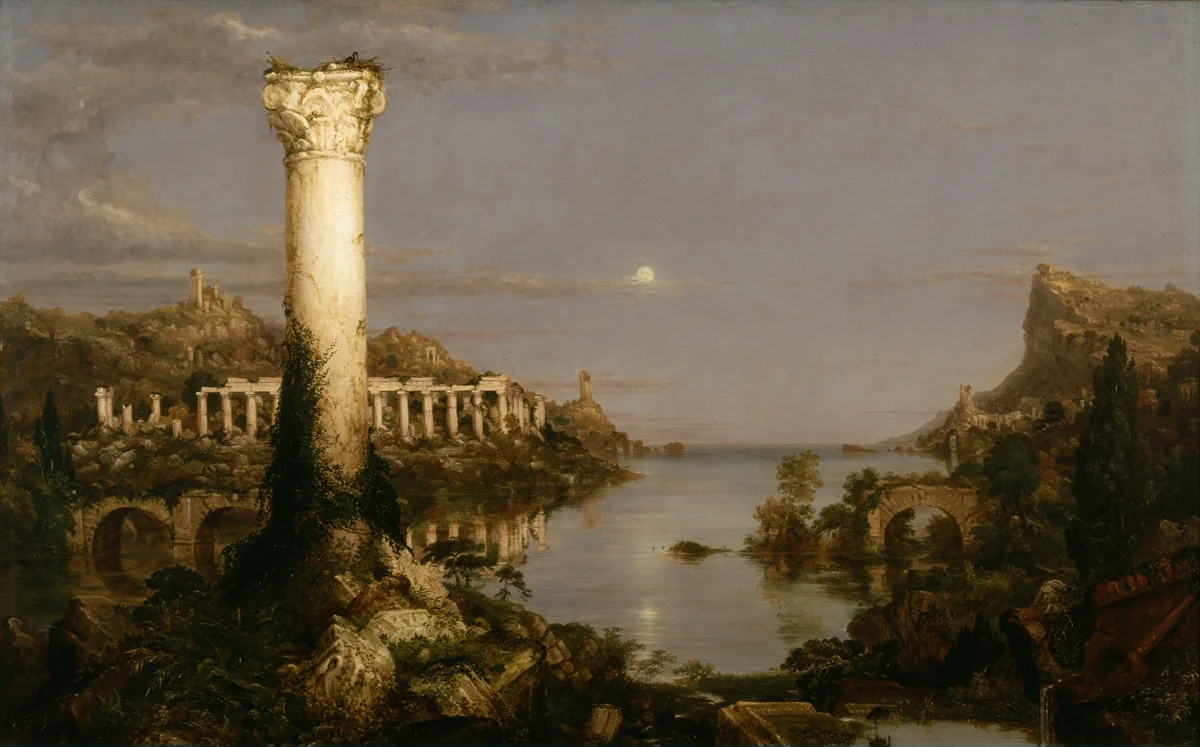
“Time ceased and the beginning of things came perilously near to the end. The throne of Augustus, so recently erected, fell to pieces, and emptiness took the place of the throne and of Augustus. Rome fell silently into ruins. A new city rose in its place, and it too was erased by emptiness.”
“You have killed me, Lazarus,” he says, already indifferent. And then something saves him:
“He thought of the people, whose shield he was destined to be, and a sharp, redeeming pang pierced his dull heart. He thought of them doomed to perish, and he was filled with anguish. First they seemed bright shadows in the gloom of the Infinite. How terrible! Then they appeared as fragile vessels with life-agitated blood, and hearts that knew both sorrow and great joy. And he thought of them with tenderness.”
This is the turn I think the whole story hangs on. The drunkard thought only of his pleasure, the sculptor of his art, the lovers of each other, and the sage of his own mind. Augustus is the first one to think of anybody else, and it only happens after he admits he’s beaten. What saves the most powerful man in the world is pity for everyone else who has to live in the same dark, and his power has nothing to do with it.
But it’s only half a victory. Augustus knows the horror will wait at his bedside for the rest of his life, and he can’t destroy what Lazarus knows. So he destroys the eyes it came through: “Next day, by order of the Emperor, they burned out Lazarus’ eyes with hot irons and sent him home. Even Augustus dared not kill him.” The empire of the living survives by refusing to look.
One historical note. The real Augustus died in AD 14, years before the events of the Gospel story, and there were no Christians yet for him to ask Lazarus about, though he does. I don’t think it’s a slip. Augustus was the emperor when Jesus was born, the one Luke’s Gospel names in its Christmas story, and Rome worshipped him as a god. Andreyev sends the man Jesus brought back from death to the man Rome worshipped as the god of this life.
The cross on the sunset
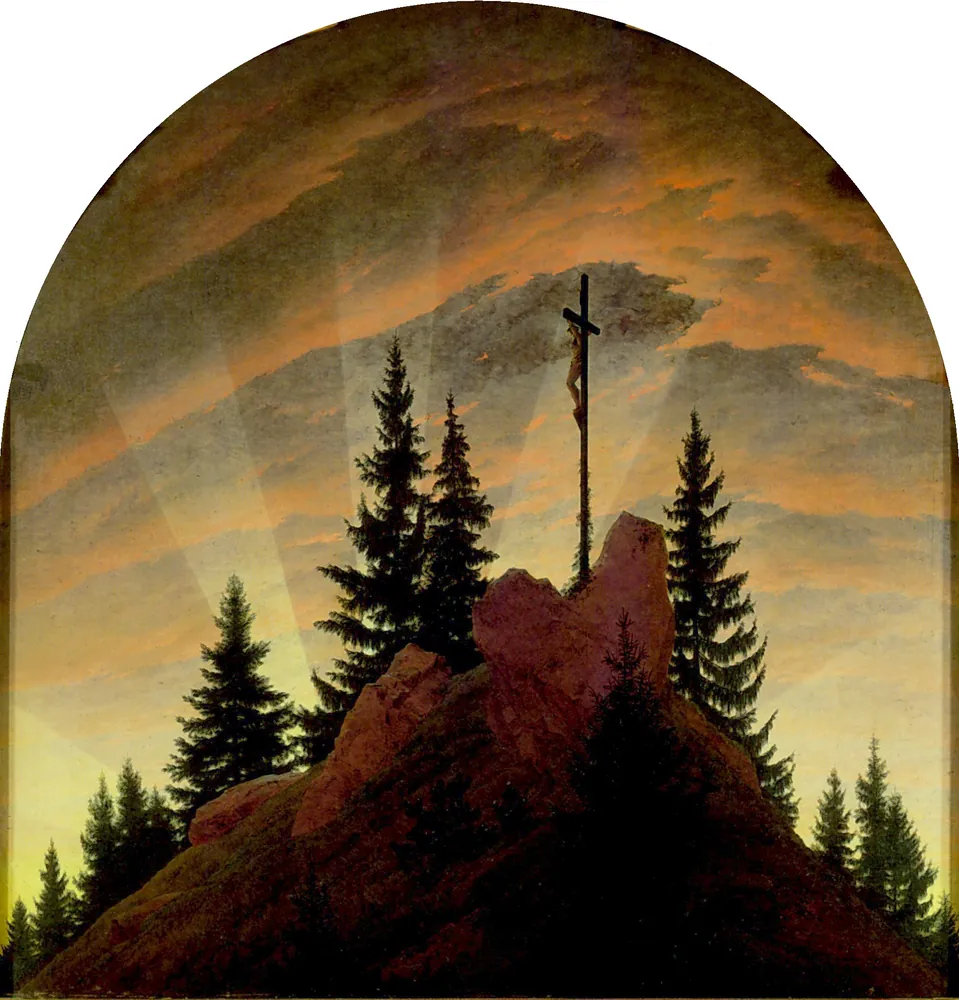
Lazarus goes home to his stone in the desert. His neighbors have all moved away, and the blinding didn’t even work: his knowledge, driven from his eyes into his brain, now “lay there in ambush.” He still follows the sun every evening, blind, falling over stones and getting up again:
“And against the red curtain of sunset his dark form and outstretched arms gave him the semblance of a cross.
“It happened once that he went and never returned. Thus ended the second life of Lazarus, who for three days had been in the mysterious thraldom of death and then was miraculously raised from the dead.”
What did Lazarus see?
The story never answers, and I keep going back and forth. I see two readings, and the text supports both.
The first is that he saw paradise and wants to go back. He sits in the sun and calls it pleasant, the only pleasure he ever admits to. He walks toward the sunset every night, even blind. He’s dressed as a bridegroom waiting for a bride nobody names. And when Augustus looks into his eyes, the first thing he finds there is “quiet rest,” “a compassionate sister, a mother.” In John’s Gospel, right before Jesus calls Lazarus out of the tomb, “Jesus wept.” Maybe being brought back was the loss.
The second is that whatever waits There is a horror the living can’t survive knowing. The people who meet his gaze come back trembling before “the dread of the Infinite.” His last look, with no eyes left, is “dull and horrible.” What the survivors describe is emptiness, loneliness down to the particles, and the sage learns the hard way that you can’t imagine it in advance. You can only go through it.
I don’t think these two cancel each other out. The void Augustus sees starts as a fond mistress and a mother and ends as cold nails sinking into his heart. If that’s what’s There, you could long to go back and be terrified of it at the same time. I think most of us live the way Rome does in this story, painting laughter lines over the thing and trying not to look it in the eye.
Where it stumbles
My one real complaint is the parade in Rome. The drunkard, the lovers, and the sage arrive one after another like figures in a morality play, each with a single trait and a single scene, and after Aurelius, whose section is the richest in the story, they feel schematic. They do their job, setting up Augustus by showing everything that fails before him, but they’re the one stretch where you can see the argument’s machinery.
It’s also worth knowing that the two English versions read differently. The 1907 translation quoted here is lush and a little old-fashioned. Yarmolinsky’s 1918 version is plainer. Neither is bad, and if one doesn’t grab you, try the other.
Should you read it?
Yes, if you can take something genuinely bleak. It’s short, it’s free, and it’s one of the purest pieces of cosmic horror ever written, in a story that takes religion seriously enough to turn it upside down. Every defense we have against death gets knocked down: joy, family, art, pleasure, love, wisdom, and power. The one thing that holds is pity for everyone else stuck in the dark, and even that ends with a hot iron.
You can read the 1907 translation at Online Literature or Yarmolinsky’s 1918 translation on Wikisource. If it gets under your skin, Andreyev’s The Seven Who Were Hanged is the natural next step. And for another story about people who have lost the ability to care whether anything lives or dies, read my review of Paolo Bacigalupi’s “The People of Sand and Slag”.
Which reading do you buy? Did Lazarus see paradise, or something worse? Tell me in the comments.
FAQs
What is “Lazarus” by Leonid Andreyev about?
Andreyev’s 1906 story imagines the life of Lazarus after Jesus raises him from the dead. He comes back bloated and changed, never says what he saw, and anyone who meets his gaze loses the will to live. His family abandons him, a Roman sculptor and a series of visitors are broken by him, and finally the emperor Augustus faces him, survives by thinking of his people, and has Lazarus’s eyes burned out. Lazarus returns to the desert and one evening walks toward the sunset and never comes back.
What did Lazarus see in the story?
The story never says directly. The only description comes from survivors of his gaze, who describe a boundless darkness and emptiness that separates everything from everything else, “the particles of the particles became lonely,” with no sense of time. There’s no hell and no heaven in their account. Some details suggest he longs to return to what he saw, while others suggest it’s a horror no living person can bear.
Is “Lazarus” cosmic horror?
It’s one of the earliest examples. The terror comes from knowledge of a vast, indifferent emptiness too large for the human mind, the same idea H.P. Lovecraft later made famous. The story ran in English in Weird Tales in March 1927, the magazine that published Lovecraft, and he owned other books by Andreyev.
Why does Augustus appear in the story when he died before Lazarus was raised?
The real Augustus died in AD 14, before the events of the Gospel story. The anachronism seems deliberate: Augustus was the emperor when Jesus was born and was worshipped in Rome as a god, so the story sets the man raised from death against the ruler who stands for this life. He’s the last and strongest of the defenses against death the story tests.
When was “Lazarus” written and translated?
Andreyev wrote it in 1906, under the title “Eleazar.” An anonymous English translation appeared in Current Literature in May 1907, and Abraham Yarmolinsky published another in 1918. Both are in the public domain and free to read online.
Who was Leonid Andreyev?
A Russian writer (1871-1919), born in Oryol, who worked as a court reporter before Maxim Gorky encouraged his fiction. He became famous for dark, intense work like The Red Laugh, The Seven Who Were Hanged, and the play He Who Gets Slapped. He opposed the Bolsheviks, moved to Finland in 1917, and died there in 1919.
Sources
- Leonid Andreyev, “Lazarus,” anonymous translation, Current Literature (May 1907), text at Online Literature (all quotations checked against it; dashes inside quotations are rendered as commas)
- Leonid Andreyev, “Lazarus,” trans. Abraham Yarmolinsky (1918), Wikisource
- Wikipedia, “Leonid Andreyev” (life, Gorky, his wife’s death, major works, Finland)
- Ruthanna Emrys and Anne M. Pillsworth, “Things Man Should Still Avoid Knowing,” Reactor (2020) (Weird Tales, March 1927, and the Andreyev books Lovecraft owned)
- Gregory Zilboorg, introduction to He Who Gets Slapped, Standard Ebooks (Tolstoy’s remark)
- Wikipedia, “Lazarus (short story)” (publication year and translations)
- Images via Wikimedia Commons: Repin, Portrait of Leonid Andreyev; Lovecraft, 1934; Rembrandt, The Raising of Lazarus; Holbein, The Body of the Dead Christ in the Tomb (photo by Moleskine, CC BY-SA 4.0); Van Gogh, The Sower; Merian, Metamorphosis plate (CC0); Augustus of Prima Porta (photo by Till Niermann); Cole, Desolation; Friedrich, The Cross in the Mountains; and Redon, The Eye, Like a Strange Balloon
SOURCE · Leonid Andreyev, "Lazarus" (published 1906).
Transmissions from ground control